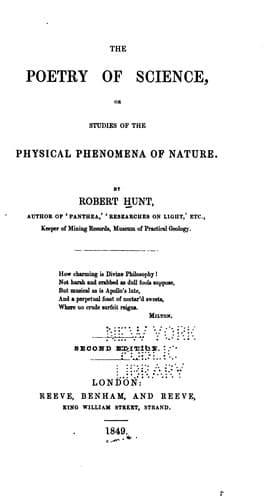
The Poetry of Science; or, Studies of the Physical Phenomena of NatureHunt, Robert
Philosophy
The Poetry of Science; or, Studies of the Physical Phenomena of Nature
Hunt, Robert
Physics; Science
The phosphorescence of animals is amongst the most surprising of
nature’s phenomena, and it is not the less so from our almost entire
ignorance of the cause of it. Many very poetical fancies have been
applied in description of these luminous creations; and imagination
has found reason why they should be gifted with these extraordinary
powers. The glow-worm lights her lamp to lure her lover to her bower,
and the luminous animalcules of the ocean are employed in lighting up
the fathomless depths where the sun’s rays cannot penetrate, to aid its
monsters in their search for prey. “The lamp of love--the pharos--the
telegraph of the night,--which scintillates and marks, in the silence
of darkness, the spot appointed for the lover’s rendezvous,”[109] is
but a pretty fiction; for the glow-worm shines in its infant state,
in that of the larva, and when in its aurelian condition. Of the
dark depths of the ocean it may be safely affirmed that no organized
creation lives or moves in its grave-like silence to require this
fairy aid. Fiction has frequently borrowed her creations from science.
In these cases science appears to have made free with the rights of
fiction.
The glow-worms (_lampyris noctiluca_), it is well known, have the
power of emitting from their bodies a beautiful pale bluish-white
light, shining during the hours of night in the hedge-row, like crystal
spheres. It appears, from the observations of naturalists, that these
insects never exhibit their light without some motion of the body or
legs;--from this it would seem that the phosphorescence was dependent
upon nervous action, regulated at pleasure by the insect; for they
certainly have the power of obscuring it entirely. If the glow-worm is
crushed, and the hands or face are rubbed with it, luminous streaks,
similar to those produced by phosphorus, appear. They shine with
greatly increased brilliancy in oxygen gas and in nitrous oxide. From
these facts may we not infer that the process by which this luminosity
is produced, whatever it may be, has a strong resemblance to that of
respiration?
There are several varieties of flies, and three species of beetles of
the genus _Elater_, which have the power of emitting luminous rays.
The great lantern-fly of South America is one of the most brilliant, a
single insect giving sufficient light to enable a person to read. In
Surinam a very numerous class of these insects are found, which often
illuminate the air in a remarkable manner. In some of the bogs of
Ireland a worm exists which gives out a bright green light; and there
are many other kinds of creatures which, under certain circumstances,
become luminous in the dark. This is always dependent upon vitality;
for all these animals, when deprived of life, cease to shine.
Public-domain text, read in full here on John Shaqi.
Reviews
Reviews
No reviews yet
Be the first to share your thoughts on this work.
Elsewhere in the archive
Join the Discussion
Join the discussion
Sign in to leave a comment or review.
Sign InorCreate an account