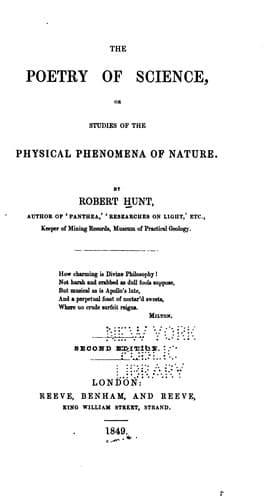
The Poetry of Science; or, Studies of the Physical Phenomena of NatureHunt, Robert
Philosophy
The Poetry of Science; or, Studies of the Physical Phenomena of Nature
Hunt, Robert
Physics; Science
Numerous experiments have been made from time to time on the influence
of light upon animal life. It has been proved that the excitement of
the solar rays is too great for the healthful growth of young animals;
but, at the same time, it appears probable that the development of
the functional organs of animals requires, in some way, the influence
of the solar rays. This might, indeed, have been inferred from the
discovery that animal life ceases in situations from which light is
absolutely excluded. The instance of the Proteus of the Illyrian lakes
may appear against this conclusion. This remarkable creature is found
in the deep and dark recesses of the calcareous rocks of Adelsburg, at
Sittich; and it is stated, also in Sicily, and in the Mammoth caves
of Kentucky. Sir Humphry Davy describes the Proteus anguinus as “an
animal to whom the presence of light is not essential, and who can
live indifferently in air and in water, on the surface of the rock,
or in the depths of the mud.” The geological character of rocks,
however, renders it extremely probable that these animals may have
descended with the water, percolating through fissures from very near
the surface of the ground. All the facts with which science has made us
acquainted--and both natural and physical science has been labouring
with most untiring industry in the pursuit of truth--go to prove
that light is absolutely necessary to organization. It is possible
the influence of the solar radiations may extend beyond the powers
of the human senses to detect luminous or thermic action, and that
consequently a development of animal and vegetable forms may occur
where the human eye can detect no light; and under such conditions
the Proteus may be produced in its cavernous abodes, and also those
creatures which live buried deep in mud. Some further consideration of
the probable agency of light will occupy us, when we come to examine
the phenomena of vital forces.
Light is essentially necessary to vegetable life; and to it science
refers the powers which the plant possesses of separating carbon from
the air breathed by the leaves, and secreting it within its tissues for
the purpose of adding to its woody structure. As, however, we have, in
the growing plant, the action of several physical powers exerted to
different ends at the same time, the remarkable facts which connect
themselves with vegetable chemistry and physiology are deferred for a
separate examination.
The power of the solar rays to produce in bodies that peculiar gleaming
light which we call phosphorescence, and the curious conditions under
which this phenomenon is sometimes apparent, independent of the sun’s
direct influence, present a very remarkable chapter in the science of
luminous powers.
Public-domain text, read in full here on John Shaqi.
Reviews
Reviews
No reviews yet
Be the first to share your thoughts on this work.
Elsewhere in the archive
Join the Discussion
Join the discussion
Sign in to leave a comment or review.
Sign InorCreate an account