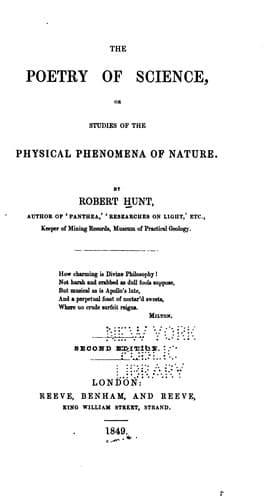
The Poetry of Science; or, Studies of the Physical Phenomena of NatureHunt, Robert
Philosophy
The Poetry of Science; or, Studies of the Physical Phenomena of Nature
Hunt, Robert
Physics; Science
“On the 19th of June, 1799, late in the evening, when the twilight was
deepening into a clear night, as I was walking up and down the garden
with a friend, we very distinctly observed a flame-like appearance
near the oriental poppy, the flowers of which are remarkable for their
powerful red colour. We approached the place, and looked attentively
at the flowers, but could perceive nothing further, till at last, by
passing and repassing repeatedly, while we looked side-ways on them, we
succeeded in renewing the appearance as often as we pleased. It proved
to be a physiological phenomenon, and the apparent corruscation was
nothing but the spectrum of the flower in the complementary blue-green
colour. The twilight accounts for the eye being in a perfect state
of repose, and thus very susceptible, and the colour of the poppy is
sufficiently powerful in the summer twilight of the longest days to act
with full effect, and produce a complementary image.”[110]
The leaves of the _œnothera macrocarpa_ are said to exhibit phosphoric
light when the air is highly charged with electricity. The agarics
of the olive-grounds of Montpelier have been observed to be luminous
at night; but they are said to exhibit no light, even in darkness,
_during the day_. The subterranean passages of the coal mines near
Dresden are illuminated by the phosphorescent light of the _rhizomorpha
phosphoreus_, a peculiar fungus. On the leaves of the Pindoba palm, a
species of agaric grows which is exceedingly luminous at night; and
many varieties of the lichens, creeping along the roofs of caverns,
lend to them an air of enchantment by the soft and clear light which
they diffuse. In a small cave near Penryn, a luminous moss is abundant;
and it is also found in the mines of Hesse. According to Heinzmann, the
_rhizomorpha subterranea_ and _aidulæ_ are also phosphorescent.
It is but lately that a plant which abounds in the jungles in the
Madura district of the East Indies was sent to this country, which,
although dead, was remarkably phosphorescent; and, when in the
living state, the light which it emitted was extraordinarily vivid,
illuminating the ground for some distance. Those remarkable effects
may be due, in some cases, to the separation of phosphuretted hydrogen
from decomposing matter, and, in others, to some peculiar electric
manifestation.
Public-domain text, read in full here on John Shaqi.
Reviews
Reviews
No reviews yet
Be the first to share your thoughts on this work.
Elsewhere in the archive
Join the Discussion
Join the discussion
Sign in to leave a comment or review.
Sign InorCreate an account