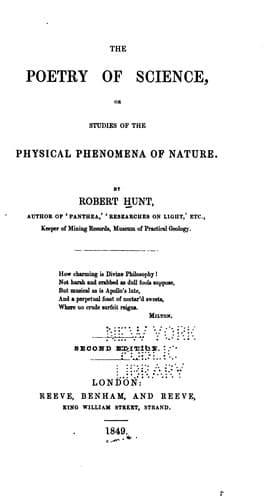
The Poetry of Science; or, Studies of the Physical Phenomena of NatureHunt, Robert
Philosophy
The Poetry of Science; or, Studies of the Physical Phenomena of Nature
Hunt, Robert
Physics; Science
The phosphorescence of the sea, or that condition called by fishermen
_brimy_, when the surface, being struck by an oar, or the paddle-wheels
of a steamer, gives out large quantities of light, has been attributed
to the presence of myriads of minute insects which have the power
of emitting light when irritated. The night-shining nereis (_Nereis
noctiluca_) emits a light of great brilliancy, as do several kinds of
the mollusca. The nereides attach themselves to the scales of fishes,
and thus frequently render them exceedingly luminous. Some of the
crustaceæ possess the same remarkable property;--twelve different
species of _cancer_ were taken up by the naturalists of the Zaire
in the Gulf of Guinea.[111] The _cancer fulgens_, discovered by Sir
Joseph Banks, is enabled to illuminate its whole body, and emits
vivid flashes of light. Many of the medusæ also exhibit powerful
phosphorescence.[112] These noctilucous creatures are, many of them,
exceedingly minute, several thousands being found in a tea-cup of sea
water. They float near the surface in countless myriads, and when
disturbed they give out brilliant scintillations, often leaving a train
of light behind them.[113] By microscopic examination no other fact has
been elicited than that these minute beings contain a fluid which, when
squeezed out, leaves a line of light upon the surface of water. The
appearance of these creatures is almost invariably on the eve of some
change of weather, which would lead us to suppose that their luminous
phenomena must be connected with electrical excitation; and of this,
the investigations of Mr. C. Peach, of Fowey, communicated to the
British Association at Birmingham, furnish the most satisfactory proofs
we have as yet obtained.
Benvenuto Cellini gave a curious account of a carbuncle which shone
with great brilliancy in the dark.[114] The same thing has been stated
of the diamond; but it appears to be necessary to procure these
emissions of light, that the minerals should be first warmed near a
fire. From this it may be inferred that the luminous appearance is
of a similar character to that of fluor spar, and of numerous other
earthy minerals, which, when exposed to heat, phosphoresce with great
brilliancy. Phosphorescent glow can also be excited in similar bodies
by electricity, as was first pointed out by Father Beccaria, and
confirmed by Mr. Pearsall.[115] These effects, it must be remembered,
are distinct from the electric spark manifested upon breaking white
sugar in the dark, or scratching sulphuret of zinc.
Public-domain text, read in full here on John Shaqi.
Reviews
Reviews
No reviews yet
Be the first to share your thoughts on this work.
Elsewhere in the archive
Join the Discussion
Join the discussion
Sign in to leave a comment or review.
Sign InorCreate an account