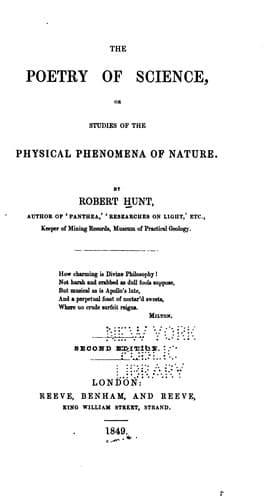
The Poetry of Science; or, Studies of the Physical Phenomena of NatureHunt, Robert
Philosophy
The Poetry of Science; or, Studies of the Physical Phenomena of Nature
Hunt, Robert
Physics; Science
It has been stated that matter is necessary to the development of
light; that no luminous effect would be produced if it were not for
the presence of matter. Of this we not only have no proof, but such
evidence as we have is against the position. There is no loss of light
in the most perfect vacuum we can produce by any artificial means,
which should be the case if matter was concerned in the phenomena of
light, as a cause.
Colour is certainly a property regulated by material bodies; or
rather, the presence of matter is necessary to the production of
colour. Chlorine gas is a pale yellow, and nitrous vapour a yellowish
red. These and one or two other vapours, which are near the point of
condensation into fluids, are the only coloured gaseous or vaporiform
bodies. The sky is blue, because the material particles of the
atmosphere reflect back the blue rays. But we have more practical
illustrations than this. The flame of hydrogen burning with oxygen
gives scarcely any light; allow it to impinge on lime, a portion of
which is carried off by the heat of the flame, and the most intense
artificial light with which we are acquainted is produced. Hydrogen gas
alone gives a flame in which nearly all but the blue rays are wanting:
place a brush of steel or asbestos in it, and many of the other rays
are at once produced. An argand lamp, and more particularly the lamp
in which camphine--a purified turpentine,--is burnt, gives a flame
which emits most of the rays found in sunlight. Spirit of wine mixed
with water, warmed and ignited, gives only yellow rays; add nitrate
of strontian and they become red; but nitrate of barytes being mixed
with the fluid, they are changed to green and yellow; salts of copper
afford fine blue rays, and common salt intense yellow ones. Many of
these coloured rays and others can be produced in great power by the
use of various solid bodies introduced into flame. This has not been
sufficiently pointed out by authors; but it is clear from experiments
that light requires the presence of matter to enable it to diffuse its
coloured glories. How is it that the oxygen and hydrogen flame gives so
little light, and with a solid body present, pours forth such a flood
of brilliancy?
The production of artificial light by electrical and chemical agencies
will necessarily find some consideration under their respective
heads. There are numerous phenomena which connect themselves with
luminous power, or appear to do so, which, in the present state of
our knowledge, cannot come immediately under our attention. We are
compelled to reserve our limited space for those branches of science
which we are enabled to connect with the great natural operations
constantly going on around us. Many of these more abstruse results
will, however, receive some incidental notice when we come to examine
the operation of the combined physical forces on matter.
Public-domain text, read in full here on John Shaqi.
Reviews
Reviews
No reviews yet
Be the first to share your thoughts on this work.
Elsewhere in the archive
Join the Discussion
Join the discussion
Sign in to leave a comment or review.
Sign InorCreate an account