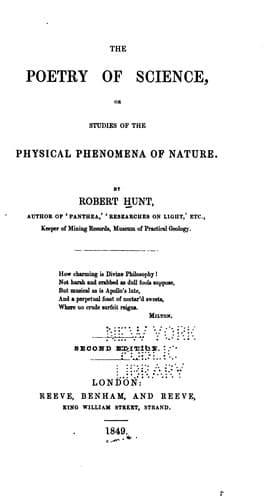
The Poetry of Science; or, Studies of the Physical Phenomena of NatureHunt, Robert
Philosophy
The Poetry of Science; or, Studies of the Physical Phenomena of Nature
Hunt, Robert
Physics; Science
In the instances adduced there is not necessarily any exposure to the
sunshine required. It is probable that two, if not three, distinct
phenomena are concerned in the cases above quoted, and that all of them
are distinct from animal phosphorescence, or the luminous appearance
of vegetables. They, however, certainly prove, either that light is
capable of becoming latent, or that it is only a condition of matter,
in which it may be made manifest by any disturbance of the molecular
forces. We have, in answer to this, very distinct evidence that
some bodies do derive this property from the solar rays. Canton’s
phosphorus, which is a sulphuret of calcium, will, having been exposed
to the sun, continue luminous for some time after it is carried into
the dark; as will also the Bolognian stone,--a sulphuret of barium.
This result appears to be due to a particular class of the solar rays;
for it has been found, if these sulphurets, spread smoothly on paper,
are exposed to the influence of the solar spectrum for some little
time, and then examined in the dark, that luminous spaces appear,
exactly corresponding with the most refrangible rays, or those which
excite chemical change; and one very remarkable fact must not be
forgotten--the dark rays of the spectrum beyond the violet produce a
lively phosphorescence, which is _extinguished_ by the action of the
rays of least refrangibility, or the heat rays--whilst artificial heat,
such as a warm iron, produces a very considerable elevation of the
phosphorescent effect.[116] It is not improbable, that the fluorescent
rays of Mr. Stokes may be materially concerned in producing the
phenomena of phosphorescence: experiments are, however, required to
prove this.
In these allied phenomena we have effects which are evidently dependent
upon several dissimilar causes. The phosphorescence of the living
animal is due, without doubt, to nervous excitation: that of the living
vegetable to solar luminous influence; and in the case of the mosses of
caverns, &c. to the chemical agency of the sun’s rays, which appears to
be capable of conduction. In the dead organic matter we have a purely
chemical action developing the light, and in the inorganic bodies we
have peculiar molecular constitution, by which an absorption of light
appears to take place.
The subject is one of the greatest difficulty; the torch of science
is too dim to enable us to see the causes at work in producing these
marvellous effects. The investigation leads, to a certain extent, to
the elucidation of many of the secrets of luminous action; and the
determination of the question, whether light is an emanation from the
sun, or only a subtile principle diffused through all matter, which is
excited by solar influence, is intimately connected with the inquiry.
Public-domain text, read in full here on John Shaqi.
Reviews
Reviews
No reviews yet
Be the first to share your thoughts on this work.
Elsewhere in the archive
Join the Discussion
Join the discussion
Sign in to leave a comment or review.
Sign InorCreate an account