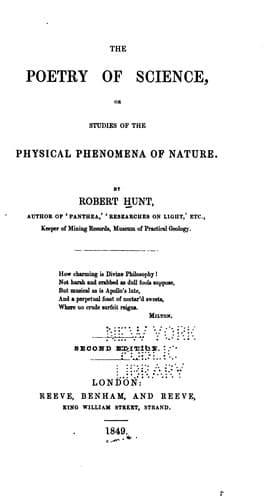
The Poetry of Science; or, Studies of the Physical Phenomena of NatureHunt, Robert
Philosophy
The Poetry of Science; or, Studies of the Physical Phenomena of Nature
Hunt, Robert
Physics; Science
[91] _Report on the Mollusca and Radiata of the Ægean Sea, and on their
distribution, considered as bearing on Geology._ By Edward Forbes,
F.R.S., &c.--Reports of the British Association, vol. xii. Professor
Forbes remarks:--“A comparison of the testacea, and other animals of
the lowest zones, with those of the higher, exhibits a very great
distinction in the hues of the species, those of the depths being, for
the most part, white or colourless, while those of the higher regions,
in a great number of instances, exhibit brilliant combinations of
colour. The results of an enquiry into this subject are as follows:--
“The majority of shells of the lowest zone are white or transparent; if
tinted rose is the hue, a very few exhibit markings of another colour.
In the seventh region, white species are also very abundant, though
by no means forming a proportion so great as the eighth. Brownish
red, the prevalent hue of the brachiopoda, also gives a character
of colour to the fauna of this zone; the crustacea found in it are
red. In the sixth zone the colours become brighter, reds and yellows
prevailing,--generally, however, uniformly colouring the shell. In
the fifth region many species are banded or clouded with various
combinations of colours, and the number of white species has greatly
diminished. In the fourth, purple hues are frequent, and contrasts of
colour common. In the second and third, green and blue tints are met
with, sometimes very vivid; but the gayest combinations of colour are
seen in the littoral zone, as well as the most brilliant whites.
“The animals of Testacea, and the Radiata of the higher zones, are
much more brilliantly coloured than those of the lower, where they are
usually white, whatever the hue of the shell may be. Thus the genus
_Trochus_ is an example of a group of forms mostly presenting the
most brilliant hues both of shell and animal; but whilst the animals
of such species as inhabit the littoral zone are gaily chequered with
many vivid hues, those of the greater depth, though their shells are
almost as brightly covered as the coverings of their allies nearer the
surface, have their animals, for the most part, of a uniform yellow or
reddish hue, or else entirely white. The chief cause of this increase
of intensity of colour as we ascend is, doubtless, the increased amount
of light above a certain depth.”--p. 172.
[92] Ἁμὁρφωτα. _On the Epipolic Dispersion of Light_, being a paper
entitled, _On a case of Superficial Colour presented, by a homogeneous
liquid internally colourless_. By Sir J. F. W. Herschel, Bart, K.H.,
F.R.S., &c.--_An epipolized beam of light_ (meaning thereby a beam
which has once been transmitted through a quiniferous solution, and
undergone its dispersing action) _is incapable of further undergoing
epipolic dispersion_. In proof of this the following experiment may be
adduced,--
Public-domain text, read in full here on John Shaqi.
Reviews
Reviews
No reviews yet
Be the first to share your thoughts on this work.
Elsewhere in the archive
Join the Discussion
Join the discussion
Sign in to leave a comment or review.
Sign InorCreate an account