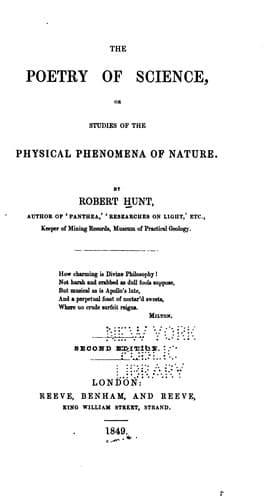
The Poetry of Science; or, Studies of the Physical Phenomena of NatureHunt, Robert
Philosophy
The Poetry of Science; or, Studies of the Physical Phenomena of Nature
Hunt, Robert
Physics; Science
A glass jar being filled with a quiniferous solution, a piece of plate
glass was immersed in it vertically, so as to be entirely covered, and
to present one face directly to the incident light. In this situation,
when viewed by an eye almost perpendicularly over it, so as to graze
either surface very obliquely, neither the anterior nor posterior face
showed the slightest trace of epipolic colour. Now, the light, at its
egress from the immersed glass, entered the liquid under precisely the
same circumstances as that which, when traversing the anterior surface
of the glass jar, underwent epipolic dispersion on first entering
the liquid. It had, therefore, lost a property which it originally
possessed, and could not, therefore, be considered _qualitatively_ the
same light.--Philosophical Transactions, vol. cxxxvi.
[93] In connection with this view, the Newtonian theory should be
consulted, for which see--_A Letter of_ Mr. Isaac Newton, _Professor
of the Mathematicks in the University of Cambridge; containing his new
Theory about Light and Colors: sent by the Author to the Publisher,
from Cambridge, Feb. 6, 1671-72, in order to be communicated to the
Royal Society._
[94] In that admirable work, _The Physical Atlas_ of Dr. Berghaus, of
which a very complete edition by Alexander Keith Johnstone is published
in this country, the following order of the distribution of plants is
given:--
1. The region of palms and bananas Equatorial zone.
2. Tree ferns and figs Tropical zone.
3. Myrtles and laurels Sub-tropical zone.
4. Evergreen trees Warm temperate zone.
5. European trees Cold temperate zone.
6. Pines Sub-arctic zone.
7. Rhododendrons Arctic zone.
8. Alpine plants Polar zone.
Consult Humboldt, _Essai sur la Géographie des Plantes_, Paris,
1807; _De Distributione Geographicâ Plantarum_, Paris, 1817. Schouw,
_Grundzüge der Pflanzengeographie_. Also his _Earth, Plants, and Man_;
translated by Henfrey, in _Bohn’s Scientific Library_. Lamouroux,
_Géographie Physique_. _The Plant, a Biography_: by Schleiden;
translated by Henfrey. _Physical Geography_: by Mrs. Somerville.
[95] Fraunhofer’s measure of illuminating power is as follows:--
At the 22nd degree of the red 0·032
" 34th degree of the red 0·094
" 22nd degree of the orange 0·640
" 10th degree of the yellow 1·000
" 42nd degree of the yellow 0·480
" 2nd degree of the blue 0·170
" 16th degree of the indigo 0·031
" 43rd degree of the violet 0·0056
[96] Herschel, _On the Action of Crystallized Bodies on Homogeneous
Light, and on the causes of the deviation from Newtons scale in
the tints which many of them develope on exposure to a polarized
ray_.--Phil. Trans., vol. cx., p. 88.
Public-domain text, read in full here on John Shaqi.
Reviews
Reviews
No reviews yet
Be the first to share your thoughts on this work.
Elsewhere in the archive
Join the Discussion
Join the discussion
Sign in to leave a comment or review.
Sign InorCreate an account