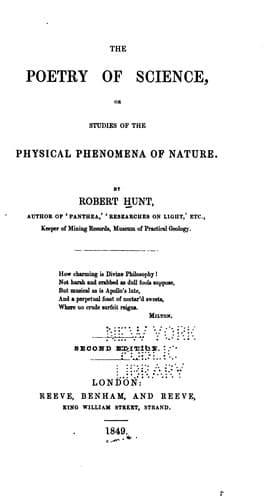
The Poetry of Science; or, Studies of the Physical Phenomena of NatureHunt, Robert
Philosophy
The Poetry of Science; or, Studies of the Physical Phenomena of Nature
Hunt, Robert
Physics; Science
The admirer of nature may copy her arrangements with the utmost
fidelity. Every modulation of the landscape, each projecting rock or
beetling tor--the sinuous river in its rapid flow--the meandering
stream, “gliding like happiness away;” and the spreading plains
over which are scattered the homes of honest industry and domestic
peace, intermingled with the towers of those humble temples in which
simple-hearted piety delights to “bow the head and bend their knee;”
these, all of these, may, by the sunbeam which illuminates the whole,
be faithfully pencilled upon our chemical preparations.
Our art enables us to do more even than this; we have but to present
our sensitive tablet to the moon, and she, by her own light, prints her
mountains and her valleys, and indicates with all truth the physical
conditions of her surface.
Any reference to the _chemical agency_ of LIGHT--_the luminous rays_ as
distinguished from the _chemical and calorific rays_--has been avoided
until we came to the consideration of this particular question of
chemical change.
Upon organic compounds, as, for instance, upon the colouring matter
of leaves and flowers, _light_ does exert a chemical power: and it
is found that vegetable colours are bleached, not by rays of their
own colour, but by those which are _complementary_ to them. A red dye
fades under the influence of a green ray, and a yellow under that of a
violet one, much more speedily than when exposed to rays of any other
colour; and this, it must be remembered, is due to the coloured ray
itself, and not to any _actinic_ power masked, as it were, behind the
colour, as is generally believed.[125] It was long a question whether
the decomposition of carbonic acid by plants was due to the luminous or
the chemical rays. It is now clearly established that the luminous rays
are the most active in producing this effect; which they do indirectly,
by exciting the vital powers of the organized structures. Therefore we
would refer this phenomenon of gaseous decomposition to a vital power
quickened by luminous excitement.[126]
We have already noticed some chemical phenomena due to heat,
particularly those experiments of Count Rumford’s, which appeared to
him to prove that the chemical agency of the sun’s rays was due to its
calorific power. Certain chemical phenomena, we know, may be produced
by thermic action; but the only variety of thermo-chemical action which
connects itself immediately with the solar radiations, belongs to a
class of rays to which the name of _Parathermic_ has been given, and to
which the scorching, as it is called, of plants, the browning of the
autumnal leaves, and the ripening of fruits, appear to be due.[127]
When we come to the consideration of those physical phenomena which
belong to the growth of plants, all these peculiarities of solar action
must be attended to in detail.
Public-domain text, read in full here on John Shaqi.
Reviews
Reviews
No reviews yet
Be the first to share your thoughts on this work.
Elsewhere in the archive
Join the Discussion
Join the discussion
Sign in to leave a comment or review.
Sign InorCreate an account