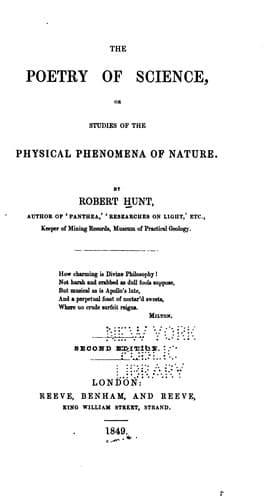
The Poetry of Science; or, Studies of the Physical Phenomena of NatureHunt, Robert
Philosophy
The Poetry of Science; or, Studies of the Physical Phenomena of Nature
Hunt, Robert
Physics; Science
The manner in which we find the actinic power influencing electrical
action, also shows us that the equilibrium of forces is continued
through all the great principles of nature. If a galvanic arrangement
is made, by which small quantities of metals may be slowly precipitated
at one of the poles in the dark, and a similar arrangement be exposed
to sunshine, it will be found that no metal is deposited: the sun’s
rays have interfered with the decomposing power of the electrical
current. At the same time we learn, that by throwing a beam of light
upon a plate of copper which forms one of a galvanic pair, whilst
it is under the influence of an acidulated solution, an additional
excitation takes place, and the galvanometer will indicate the passage
of an increased current of electricity. These two dissimilar actions
appear enigmatical; but they may, there is no doubt, receive some
solution from the influence of different rays on the contrary poles
of the battery. One thing is quite evident,--electricity suffers a
disturbance of one order, by light; and an excitement of another by its
associated principles in the sunbeam. If a yellow glass is interposed
between the galvanic arrangement and the sun, the electro-chemical
precipitation goes on in the same manner as it would in perfect
darkness, and no extra excitement is produced upon the plates of the
battery. From this it would appear that actinism and not light is to be
regarded as the disturbing power.[128] It has already been shown that
yellow media possess the power of stopping back the chemical agent.
We have already, detailed many of the peculiarities of the different
varieties of Phosphori, which would seem to be the result of light.
Phosphorescence is probably excited by those rays which produce
no direct effect upon the eye. If we spread sulphuret of calcium
upon paper, and expose it to the action of the solar spectrum, it
is found to glow (in the dark) only over those spaces occupied by
the violet rays and the ordinarily dark rays beyond them; proving
that the excitation necessary to the development of the phenomena
of phosphorescence is due to a class of rays distinct from the true
light-giving principle, and more nearly allied to that principle or
power which sets up chemical decomposition. Whether the fluorescent
rays, before mentioned, which are found so abundantly over the space
which produces the greatest phosphorescent effect, are active in
producing the phenomena, is as yet an unsolved problem.
Vision and colour, calorific action, chemical change, molecular
disturbance, electrical phenomena, and phosphorescent excitation, all,
each one with a strange duality, are connected with the sunbeam.
Public-domain text, read in full here on John Shaqi.
Reviews
Reviews
No reviews yet
Be the first to share your thoughts on this work.
Elsewhere in the archive
Join the Discussion
Join the discussion
Sign in to leave a comment or review.
Sign InorCreate an account