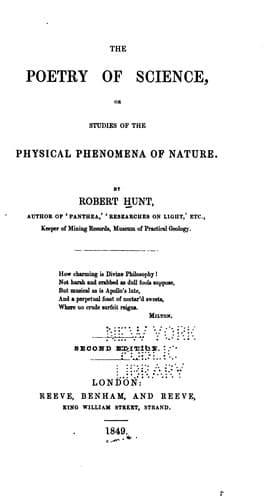
The Poetry of Science; or, Studies of the Physical Phenomena of NatureHunt, Robert
Philosophy
The Poetry of Science; or, Studies of the Physical Phenomena of Nature
Hunt, Robert
Physics; Science
[117] See _Researches on Light_, by the Author.--Reference to any of
the works of the alchemists will prove the prevalence of the idea
expressed in the text. We find that gold was considered to be always
under the influence of light and solar heat.--“It is said of gold that
it waxeth cold towards daylight, insomuch that they who wear rings of
it may perceive when the day is ready to dawn.”--_Speculum Mundi, or a
Glass representing the face of the World_. Cambridge, 1643.
[118] Daguerre’s Report to the Academy of Sciences: _La Daguerréotype
Historique, et description des procédés du Daguerréotype et du Diorama_
(Paris, 1839); particularly the description of _Heliography_, by M.
Niepce. See also the letters by Niepce, published for the first time in
_Researches on Light_.
[119] “If a solution of peroxalate of iron be kept in a dark place,
or if it be exposed to 212° of Fahr. for several hours, it does not
undergo any sensible change in its physical properties, nor does it
exhibit any phenomenon which may be considered as the result of any
elementary action.
“If, however, it be exposed to the influence of solar light in a glass
vessel provided with a tube, the concentrated solution of oxalate
of iron soon presents a very interesting phenomenon: in a short
time the solution receiving the solar rays, developes an infinite
number of bubbles of gas, which rise in the liquor with increasing
rapidity, and give the solution the appearance of a syrup undergoing
strong fermentation. This ebullition always becomes stronger, and
almost tumultuous, when an unpolished glass tube is immersed in it
with a small piece of wood; the liquid itself is afterwards thrown
into ascending and descending currents, becomes gradually yellowish,
turbid, and eventually precipitates protoxalate of iron, in the form
of small brilliant crystals of a lemon-yellow colour, gas continuing
to evolve.” _Chemical action of light, and formation of Humboldtine
by it_; Phil. Mag., 1832, second series.--“When a solution of
platinum in nitro-muriatic acid, in which the excess of acid has been
neutralized by the addition of lime, and which has been well cleared
by filtration, is mixed with lime-water in the dark, no precipitation
to any considerable extent takes place for a long while,--indeed, none
whatever, though after very long standing a slight flocky sediment
is formed, after which the action is arrested entirely. But if the
mixture, either freshly made or when cleared by subsidence of this
sediment, is exposed to sunshine, it instantly becomes milky, and a
copious formation of a white precipitate (or a pale yellow one, if the
platinic solution be in excess) takes place, which subsides quickly
and is easily collected. The same takes place more slowly in cloudy
daylight.”--_On the action of light in determining the precipitation of
Muriate of Platinum by Lime water_; being an extract from a letter from
Sir John F. W. Herschel, K.H., F.R.S., &c., to Dr. Daubeny.--Phil. Mag.
1832.
Public-domain text, read in full here on John Shaqi.
Reviews
Reviews
No reviews yet
Be the first to share your thoughts on this work.
Elsewhere in the archive
Join the Discussion
Join the discussion
Sign in to leave a comment or review.
Sign InorCreate an account