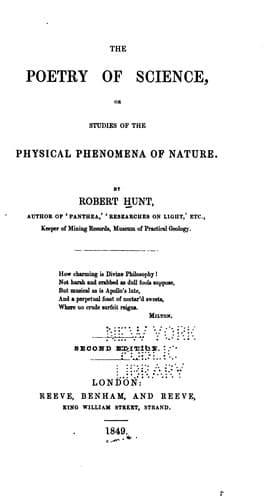
The Poetry of Science; or, Studies of the Physical Phenomena of NatureHunt, Robert
Philosophy
The Poetry of Science; or, Studies of the Physical Phenomena of Nature
Hunt, Robert
Physics; Science
Fable has told us that the magicians of the East possessed mirrors in
which they could at will produce images of the absent. Science now
shows us that representations quite sufficient to deceive the credulous
can be produced on the surface of polished metals without difficulty.
A highly polished plate of steel may be impressed with images of any
kind, which would remain invisible, the polished surface not being in
the least degree affected, as it regards its reflecting powers; but
by breathing over it, the dormant images would develope themselves,
and fade away again as the condensed moisture evaporated from the
surface.[135]
These, which are but a few selected from a series of results of an
equally striking character, serve to convince us that nature is
unceasingly at work, that every atom is possessed of properties by
which it influences every other atom in the universe, and that a most
important class of natural phenomena appear to connect themselves
directly with the radiant forces.
The alchemists observed that a change took place in chloride of silver
exposed to sunshine. Wedgwood first took advantage of that discovery to
copy pictures. Niepce pursued a physical investigation of the curious
change, and found that all bodies were influenced by this principle
radiated from the sun. Daguerre produced effects from the solar pencil
which no artist could approach to; and Talbot and others extended the
application. Herschel took up the inquiry; and he, with his usual
power of inductive search and of philosophical deduction, presented
the world with a class of discoveries which showed how vast a field of
investigation was opening for the younger races of mankind,--a field
in which a true spirit may reap the highest reward in the discovery of
new facts, and to which we must look for a further development of those
great powers with which we have already some slight acquaintance, and
for the discovery of higher influences which are not yet dreamed of in
our philosophy.
If music, with its mysteries of sound,
Gives to the human heart a heavenward feeling;
The beauty and the grandeur which are found
Spread like a vesture this fair earth around,
Creation’s wond’rous harmonies revealing,
And to the soul in truth’s strong tongue appealing,
With all the magic of those secret powers,
Which, mingling with the lovely band of light,
The sun in constant undulation showers
To mould the crystals, and to shape the flowers,
Or give to matter the immortal might
Of an embracing soul--should, from this sod,
Exalt our aspirations all to God.
FOOTNOTES:
Public-domain text, read in full here on John Shaqi.
Reviews
Reviews
No reviews yet
Be the first to share your thoughts on this work.
Elsewhere in the archive
Join the Discussion
Join the discussion
Sign in to leave a comment or review.
Sign InorCreate an account