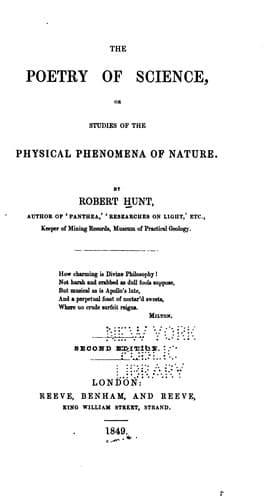
The Poetry of Science; or, Studies of the Physical Phenomena of NatureHunt, Robert
Philosophy
The Poetry of Science; or, Studies of the Physical Phenomena of Nature
Hunt, Robert
Physics; Science
Although we discover, in all the processes of nature, the
manifestations of this principle or force in its characteristic
conditions, it will be necessary, before we regard the great phenomena,
to examine the known sources from which we can most readily evoke the
mighty power of electricity. If we rub a piece of glass or resin, we
readily render this agent active; these substances appear, by this
excitement, to become surrounded by an attractive or a repellent
atmosphere. Let us rub a strip of writing paper with Indian rubber,
or a strip of Gutta Percha with the fingers, in the dark, and we have
the manifestation of several curious phenomena. We have a peculiar
attracting power; we have a luminous discharge in the shape of a spark;
and we have very sensible evidence of muscular disturbance produced by
applying the knuckle to the surface of the material. In each case we
have the development of the same power.
Every substance in nature is an electric, and, if so disposed that its
electricity may not fly off as it is developed, we may, by friction,
manifest its presence, and, indeed, measure its quantity or its force.
All bodies are not, however, equally good electrics; shell-lac, amber,
resins, sulphur, and glass, exhibiting more powerfully the phenomena
of frictional or mechanical electricity, than the metals, charcoal,
or plumbago. Solid bodies allow this peculiar principle to pass along
them also in very different degrees. Thus electricity travels readily
through copper and most other metals, platinum being the worst metallic
conductor. It also passes through living animals and vegetables, smoke,
vapour, rarified air, and moist earth; but it is obstructed by resins
and glass, paper when dry, oils, and dry metallic oxides, and in a very
powerful manner by Gutta Percha.[137]
If, therefore, we place an electric upon any of those non-conducting
bodies, the air around being well dried, we are enabled to gather
a large quantity of the force for the production of any particular
effect. Taking advantage of this fact, arrangements are made for the
accumulation and liberation at pleasure of any amount of electricity.
Public-domain text, read in full here on John Shaqi.
Reviews
Reviews
No reviews yet
Be the first to share your thoughts on this work.
Elsewhere in the archive
Join the Discussion
Join the discussion
Sign in to leave a comment or review.
Sign InorCreate an account