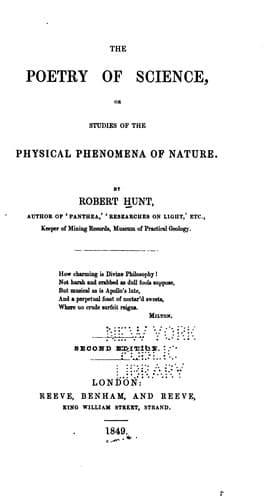
The Poetry of Science; or, Studies of the Physical Phenomena of NatureHunt, Robert
Philosophy
The Poetry of Science; or, Studies of the Physical Phenomena of Nature
Hunt, Robert
Physics; Science
A Leyden phial,--so called from its inventor, Musschenbroek, having
resided at Leyden,--is merely a glass bottle lined within and without,
to within a few inches of the top, with a metal coating. If a wire or
chain, carrying an electric current, is allowed to dip to the bottom
of the bottle, the inner coat of the jar becomes charged, or gathers
an excess, whilst the outer one is in its natural condition--one is
said to be in a _positive_, and the other in a _negative_ state. If
the two coatings are now connected by a good conductor, as a piece of
copper wire, passing from one to the other, the outside to the inside,
a discharge, arising from the establishment of the equilibrium of the
two coatings, takes place; and, if the connection is made through the
medium of our bodies, we are sensible of a severe disturbance of the
nervous system.
The cause of the conducting and non-conducting powers of bodies we know
not; they bear some relation to their conducting powers for caloric;
but they are not in exact obedience to the same laws. When we consider
that resin, a comparatively soft body, in which, consequently,
cohesive attraction is not very strong, is an imperfect conductor,
and that copper, in which cohesion is much more powerful, is a good
conductor, we may be disposed to consider that it is regulated by the
closer approximation of the particles of matter. But in platinum the
corpuscular arrangement must be much more dense than it is in copper,
and yet it is, compared with it, a very bad conductor.[138]
We have now learnt that we may, by friction, excite the electricity
in a vitreous substance; but it must not be forgotten that we cannot
increase the quantity which is, under ordinary conditions, natural to
the electric; to do so, we must in some way establish a channel of
communication with the earth, from which, through the medium we excite,
we draw our supply. We have the means of confining this mighty force
within certain limits of quantity and of time. If we place bodies which
are susceptible of electrical excitation in a sensible degree upon
insulating ones, we may retain for a considerable time the evidences of
the excitement, in the same way as with the Leyden jar; but there is a
constant effort to maintain a balance of conditions, and the body in
which we have accumulated any extraordinary quantity by conduction soon
returns to its natural state.
Public-domain text, read in full here on John Shaqi.
Reviews
Reviews
No reviews yet
Be the first to share your thoughts on this work.
Elsewhere in the archive
Join the Discussion
Join the discussion
Sign in to leave a comment or review.
Sign InorCreate an account