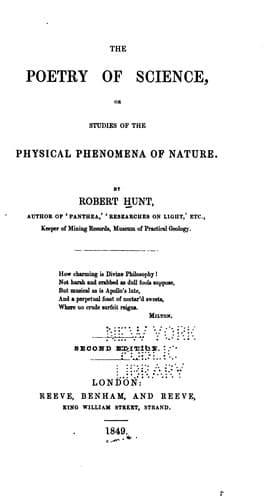
The Poetry of Science; or, Studies of the Physical Phenomena of NatureHunt, Robert
Philosophy
The Poetry of Science; or, Studies of the Physical Phenomena of Nature
Hunt, Robert
Physics; Science
A very simple means may be adopted of showing what is thought to be
one of the many evidences in favour of two electricities. If the
wire carrying the current flowing from the machine, is passed over
paper covered with nitrate of silver, it produces no change upon it;
but if the wire which conveys the current to the instrument, when
it is excited, is passed over the same paper, the silver salt is
decomposed.[139] We may, however, explain this result in a satisfactory
manner, upon the hypothesis that the decomposition is produced by the
abstraction of electricity, rather than by any physical difference in
the fluid itself. By frictional electricity we may produce curious
molecular disturbances, and give rise to molecular re-arrangements,
which have been called “electrical images,” in glass, in stone, and in
the apparently less tractable metals: these images are rendered visible
by the manner in which, according to their electrical states, some
lines receive any particular powder, or vapour, which is repelled from
other spaces. Many of the great natural phenomena, such as Lightning
and Thunder, the Aurora Borealis, and Meteors, may be imitated in a
curiously exact manner by the electrical machine and a few familiar
arrangements.[140]
Voltaic electricity, as the active force produced by chemical change
is commonly called, in honour of the illustrious Volta, is now to
be considered. It differs from frictional electricity in this:--the
electricity developed by friction of the glass plate or cylinder of
the electrical machine is a discharge with a sort of explosion. It
is electricity suddenly liberated from the highest state of tension,
whereas that which is generated by chemical action in the voltaic
battery is a steady flowing current. We may compare one to the ignition
of a mass of gunpowder at once, and the other to the slow burning of
the same quantity spread out into a very prolonged train.
There are numerous ways in which we may excite the phenomena of
Voltaism, but in all of them the decomposition of one of the elements
employed appears to be necessary. This is the case in the arrangements
of batteries in which two dissimilar metals, zinc and copper, silver
and platinum, or the like, is immersed in fluids; the zinc or the
silver are gradually converted into soluble salts, which are dissolved,
whilst the copper or platinum is protected from any action. The most
simple manner of illustrating the development of this electricity is by
placing a piece of silver on the tongue, and a piece of zinc or lead
underneath it. No effect will be observed so long as the two metals
are kept asunder, but when their edges are brought together, a slight
tremulous sensation will pass through the tongue, a saline taste be
distinguished by the palate, and if in the dark, light will be observed
by the eye.
Public-domain text, read in full here on John Shaqi.
Reviews
Reviews
No reviews yet
Be the first to share your thoughts on this work.
Elsewhere in the archive
Join the Discussion
Join the discussion
Sign in to leave a comment or review.
Sign InorCreate an account