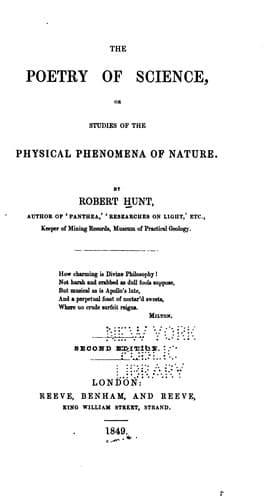
The Poetry of Science; or, Studies of the Physical Phenomena of NatureHunt, Robert
Philosophy
The Poetry of Science; or, Studies of the Physical Phenomena of Nature
Hunt, Robert
Physics; Science
Has poetry a nobler theme than this? Agencies are seen like winged
spirits of infinite power, each one working in its own peculiar way,
and all to a common end,--to produce, under the guidance of omnipotent
rule, the waters of the rivers and the seas. As the great ocean mirrors
the bright heaven which overspreads it, and reflects back the sunlight
and the sheen of the midnight stars in grandeur and loveliness; so
every drop of water, viewed with the knowledge which science has given
to us, sends back to the mind reflections of yet distant truths which,
rightly followed, will lead us upwards and onwards in the tract of
higher intelligences,--
“To the abodes where the eternals are.”
In the discoveries connected with electricity, we have results of
a more tangible character than are as yet connected with the other
physical forces; and it does appear that this science has advanced
our knowledge of nature and of the mysteries of creation far more
extensively than any other department of purely experimental inquiry.
The phenomena of electro-chemical action are so strange that we must
return for a moment to the consideration of the decomposition of
water, and the appearance of hydrogen at one pole, and of oxygen at
the other. It appears that some confusion of our ideas has arisen
from the views which have been received of the atomic constitution of
bodies. We have been accustomed to regard water,--to take that body as
an example of all,--as a compound of two gases, hydrogen and oxygen;
an equivalent, or one atom of the first, united to an equivalent or
one atom of the last, forming one atom of water. This atom of water we
regard as infinitely small; consequently a drop of water is made up of
many hundreds of these combined atoms, and a pint of water of not less
than 10,000 drops. Now, if this pint of water is connected with the
wires of a galvanic battery, although their extremities may be some
inches apart, for every atom of oxygen liberated at one pole, an atom
of hydrogen is set free at the other. It has been thought that an atom
has undergone decomposition at one point, its oxygen being torn from
it, and then there has arisen the difficulty of sending the atom of
hydrogen through all the combined atoms of water across to the other
pole. A series of decompositions and recompositions have been supposed
to take place, and the communication of effects from particle to
particle.
Public-domain text, read in full here on John Shaqi.
Reviews
Reviews
No reviews yet
Be the first to share your thoughts on this work.
Elsewhere in the archive
Join the Discussion
Join the discussion
Sign in to leave a comment or review.
Sign InorCreate an account