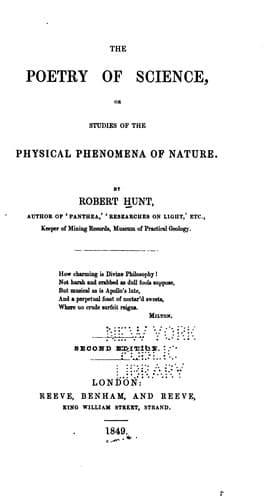
The Poetry of Science; or, Studies of the Physical Phenomena of NatureHunt, Robert
Philosophy
The Poetry of Science; or, Studies of the Physical Phenomena of Nature
Hunt, Robert
Physics; Science
An attracting power for one class of bodies has been found in one pole,
which is repellent to another class; and the reverse order has been
detected at the opposite pole of a galvanic arrangement.[144] That
is, the wire which carries the current from an excited zinc plate has
a relation to all bodies, which is directly opposite to that which
is exhibited by the wire conveying the current from, or completing
the circuit with, the copper plate. The one, for instance, collects
and carries acids and the like, the other the metallic bases. At the
extremity of one galvanic wire, placed into a drop of water, oxygen is
always liberated; and at the end of the other, necessary to complete
the circuit with the battery, hydrogen is set free.
It appears necessary, to a clear understanding of what takes place in
this experiment, that we should regard each mass, howsoever large, as
the representative of a single atom. Nor is this difficult, as the
following illustration will show.
Let us take one particle of common salt (_chloride_ of _sodium_)
weighing less than a grain, and put it into a hundred thousand grains
of distilled water. In a few minutes the salt has diffused itself
through the whole of the fluid, and in every drop we can detect
chlorine and soda. We cannot believe that this grain of salt has split
itself up into a hundred thousand parts; we conceive rather that the
phenomenon of solution is one of diffusion. One infinitely elastic body
has interpenetrated with another.
Instead of an experiment with a pint of water, let us take our stand
on Dover heights, and, with a gigantic battery at our command, place
one wire into the ocean on our own shores, and convey the other through
the air across the channel, and let its extremity dip into the sea
off Calais pier--the experiment is a practicable one--we have now an
electrical circuit of which the British channel forms a part, and the
result will be exactly the same as that which we may observe in a
watch-glass with a drop of water.
We cannot suppose that the instantaneous and simultaneous effect
which takes place in the water at Calais and at Dover, is due to
anything like what we have studied under the name of convection, when
considering Heat.
A thousand balls are placed in a line touching each other; the first
ball receives a blow, and the last ball flies off with a force exactly
equal to the power applied to the first; none of the intermediate balls
being moved.
Public-domain text, read in full here on John Shaqi.
Reviews
Reviews
No reviews yet
Be the first to share your thoughts on this work.
Elsewhere in the archive
Join the Discussion
Join the discussion
Sign in to leave a comment or review.
Sign InorCreate an account