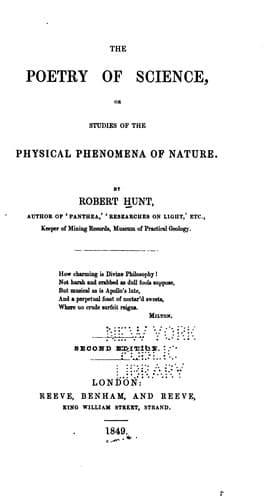
The Poetry of Science; or, Studies of the Physical Phenomena of NatureHunt, Robert
Philosophy
The Poetry of Science; or, Studies of the Physical Phenomena of Nature
Hunt, Robert
Physics; Science
Fiction has employed itself with the utmost license in giving glowing
pictures of treasures hidden in the earth’s recesses. The caverns
of Chilminar, the cave of Aladdin, the abodes of the spirits of the
Hartz, and the dwellings of the fairies of England, are gem-bespangled
and gold-glistening vaults, to which man has never reached. The
pictures are pleasing; but although they have the elements of poetry
in them, and delight the young mind, they want the sterling character
of scientific truth; and the wonderful researches of the plodding
mineralogist have developed more beauty in the caverns of the dark rock
than ever fancy painted in her happiest moments.
In all probability the action of the sun’s rays upon the earth’s
surface, producing a constantly varying difference of temperature,
and also the temperature which has been observed as existing at great
depths, give rise to thermo-electrical currents, which may play an
important part in the results thus briefly described.
In connection with these great natural operations, explaining them,
and being also, to some extent, explained by them, we have the very
beautiful application of electricity to the deposition of metals,
called the Electrotype.
Applying the views we have adopted to this beautiful discovery,[165]
the whole process by which these metallic deposits are produced will
be yet more clearly understood. By the agency of the electric fluid,
liberated in the galvanic battery, a disturbance of the electricity of
the solution of copper, silver, or gold, is produced, and the metal is
deposited; but, instead of allowing the acid in combination to escape,
it has presented to it some of the same metal as that revived, and,
consequently, it combines with it, and this compound, being dissolved,
maintains the strength of the solution.[166] A system of revival, or
decomposition, is carried on at one pole, and one of abrasion, or more
correctly speaking, of composition and solution, at the other. By
taking advantage of this very extraordinary power of electricity, we
now form vessels for ornament or use, we gild or silver all kinds of
utensils, and give the imperishability of metal to the most delicate
productions of nature--her fruits, her flowers, and her insects;--and
over the finest labours of the loom we may throw coatings of gold or
silver to add to their elegance and durability. Nor need we employ the
somewhat complex arrangement of the battery: we may take the steel
magnet, and, by mechanically disturbing the electricity it contains, we
can produce a current through copper wires, which may be used, and is
extensively employed, for gilding and silvering.[167] The earth itself
may be made the battery, and, by connecting wires with its mineral
deposits, currents of electricity have been secured, and used for the
production of electrotype deposit.[168]
Public-domain text, read in full here on John Shaqi.
Reviews
Reviews
No reviews yet
Be the first to share your thoughts on this work.
Elsewhere in the archive
Join the Discussion
Join the discussion
Sign in to leave a comment or review.
Sign InorCreate an account