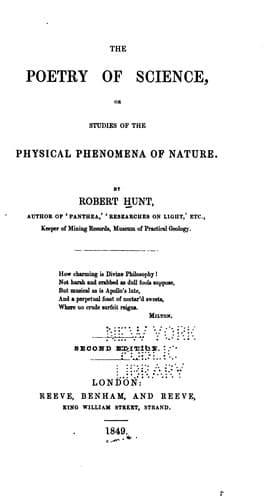
The Poetry of Science; or, Studies of the Physical Phenomena of NatureHunt, Robert
Philosophy
The Poetry of Science; or, Studies of the Physical Phenomena of Nature
Hunt, Robert
Physics; Science
The electrotype is but one of the applications of electricity to the
uses of man. This agent has been employed as the carrier of thought;
and with infinite rapidity, messages of importance, communications
involving life, and intelligences outstripping the speed of coward
crime, have been communicated. There will be no difficulty in
understanding the principle of this, although many of the nice
mechanical arrangements, to ensure precision, are of a somewhat
elaborate character. The entire action depends on the deflection of a
compass-needle by the passage of an electric current along its length.
If at a given point we place a galvanic battery, and at twenty or one
hundred miles distance from it a compass-needle, between a wire brought
from, and another returning to the battery, the needle will remain true
to its polar direction so long as the wires are unexcited; but the
moment connection is made, and the circuit is complete, the electricity
of the whole extent of wire is disturbed, and the needle is thrown at
right angles to the direction of the current. Provided a connection
between two points can be secured, however remote they are from each
other, we thus, almost instantaneously, convey any intelligence. The
effects of an electric current would appear at a distance of 576,000
miles in a second of time; and to that distance, and with that speed,
it is possible, by Professor Wheatstone’s beautiful arrangements, to
convey whispers of love or messages of destruction.
The enchanted horse of the Arabian magician, the magic carpet of the
German sorcerer, were poor contrivances, compared with the copper
wires of the electrician, by which all the difficulties of time and
the barriers of space appear to be overcome. In the Scandinavian
mythology we find certain spiritual powers of evil enabled to pass
with imperceptible speed from one remote point to another, sowing the
seeds of a common ruin amongst mankind. Such is the morbid creation
of a wild yet highly endowed imagination. The spirit of evil diffuses
itself in a remarkable manner, and, indeed, we might almost assign to
it the power of ubiquity; but in reality its advance is progressive,
and time enters as an element into any calculation on its diffusion.
Electricity is instantaneous in action; as a spirit of peace and
good-will it can overtake the spirit of evil, and divert it from its
designs. May we not hope that the electrical telegraph, making, as it
must do, the whole of the civilized world enter into a communion of
thought, and, through thought, of feeling with each other, will bind us
up in one common brotherhood, and that, instead of misunderstanding and
of misinterpreting the desires and the designs of each other, we shall
learn to know that such things as “natural enemies” do not exist? To
hope to break down the great barrier of language is perhaps too much;
but assuredly we may hope that, as we must do when closer and more
Public-domain text, read in full here on John Shaqi.
Reviews
Reviews
No reviews yet
Be the first to share your thoughts on this work.
Elsewhere in the archive
Join the Discussion
Join the discussion
Sign in to leave a comment or review.
Sign InorCreate an account