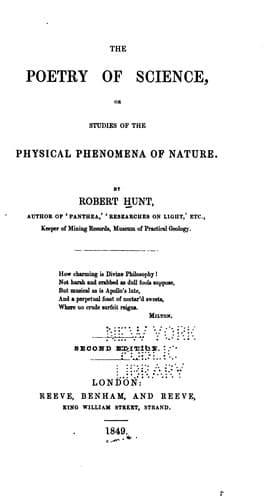
The Poetry of Science; or, Studies of the Physical Phenomena of NatureHunt, Robert
Philosophy
The Poetry of Science; or, Studies of the Physical Phenomena of Nature
Hunt, Robert
Physics; Science
“Conducting power is in some bodies powerfully increased by heat, and
in others diminished, yet without one perceiving any accompanying
essential electrical difference, either in the bodies, or in the change
occasioned by the electricity conducted.
“A numerous class of bodies insulating electricity of low intensity,
when solid, conduct it very freely when fluid, and are then decomposed
by it.
“But there are many fluid bodies which do not sensibly conduct
electricity of this low intensity; there are some which conduct it and
are not decomposed; nor is fluidity essential to decomposition.
“There are but two bodies (sulphuret of silver and fluoride of lead)
which, insulating a voltaic current when solid, and conducting it when
fluid, are not decomposed in the latter case.
“There is no strict electrical distinction of conduction which can as
yet be drawn between bodies supposed to be elementary, and those known
to be compounds.”
[138] Faraday’s _Speculation on the Nature of Matter_, already referred
to.
[139] _Experimental Researches_: by Dr. Faraday. _Chemical
Decomposition_, p. 151.
[140] Karsten; Poggendorff’s _Annalen_, vol. lvii.
[141] _Traité Expérimental de l’Électricité et du Magnétisme_:
Becquerel, 1834, Priestley’s _Introduction to Electricity_. _On
Electricity in Equilibrium_: Dr. Young’s Lectures.
[142] Faraday’s _Experimental Researches on Electricity_. This
philosopher has shown, by the most conclusive experiments, “that
the electricity which decomposes, and that which is evolved by the
decomposition of, a certain quantity of matter, are alike. What an
enormous quantity of electricity, therefore, is required for the
decomposition of a single grain of water! We have already seen that
it must be in quantity sufficient to sustain a platinum wire 1/104
of an inch in thickness, red hot, in contact with the air, for three
minutes and three quarters. It would appear that 800,000 charges of a
Leyden battery, charged by thirty turns of a very large and powerful
plate machine, in full action--a quantity sufficient, if passed at once
through the head of a rat or cat, to have killed it as by a flash of
lightning--are necessary to supply electricity sufficient to decompose
a single grain of water; or, if I am right, to equal the quantity of
electricity which is naturally associated with the elements of that
grain of water, endowing them with their mutual chemical affinity.”
[143] _Experimental Researches_: Faraday.
Public-domain text, read in full here on John Shaqi.
Reviews
Reviews
No reviews yet
Be the first to share your thoughts on this work.
Elsewhere in the archive
Join the Discussion
Join the discussion
Sign in to leave a comment or review.
Sign InorCreate an account