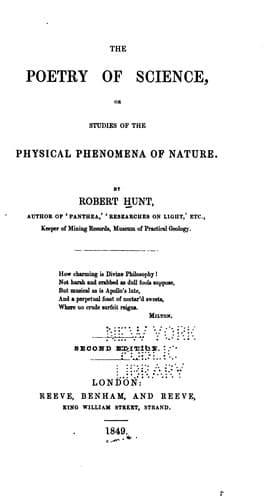
The Poetry of Science; or, Studies of the Physical Phenomena of NatureHunt, Robert
Philosophy
The Poetry of Science; or, Studies of the Physical Phenomena of Nature
Hunt, Robert
Physics; Science
The earth is spanned and the ocean pierced by the wires of the electric
telegraph. Already, from the banks of the Thames to the shores of the
Adriatic, our electric messenger will do our bidding. The telegraph
is making its way through Italy, and it is dipping its wires in the
Mediterranean, soon to reach the coast of Africa. They will then run
along the African shores to Egypt and Turkey, and still onward until
they unite with the telegraphs of India, of which three thousand miles
are in progress. From Hindostan these wondrous wires will run from
island to island in the Indian Archipelago, and thus connect Australia
and New Zealand with Europe.
In a few years we may expect to have an instantaneous report in London
of the extraordinary “nugget” discovered by some fortunate gold-digger;
and the exile from his native land in the Islands of the South Pacific
Ocean, may learn every hour, if he will, of the doings of his family
and friends in some village home of England.
FOOTNOTES:
[136] _Traité de Physique_: M. Biot, vol. vii. Becquerel: Annales
de Chimie, vol. xlvi.-xlix. Faraday’s _Experimental Researches in
Electricity_, 2 vols., 1830-1844. _A Speculation touching Electric
Conduction and the Nature of Matter_: by Michael Faraday, D.C.L.,
F.R.S.; Philosophical Magazine, vol. xxiv., 1836. _Objections to the
theories severally of Franklin, Dufay, and Ampère, with an attempt to
explain Electrical Phenomena by statical or undulatory polarization_:
by Robert Hare, M.D., Emeritus Professor of Chemistry in the University
of Pennsylvania.
[137] “A good piece of gutta percha will insulate as well as an equal
piece of shell-lac, whether it be in the form of sheet, or rod, or
filament; but being tough and flexible when cold, as well as soft
when hot, it will serve better than shell-lac in many cases where the
brittleness of the latter is an inconvenience. Thus it makes very good
handles for carriers of electricity in experiments on induction; not
being liable to fracture in the form of thin band or string, it makes
an excellent insulating suspender; a piece of it in sheet makes a
most convenient insulating basis for anything placed on it. It forms
excellent insulating plugs for the stems of gold-leaf electrometers,
when they pass through sheltering tubes, and larger plugs form good
insulating feet for electrical arrangements; cylinders of it, half an
inch or more in diameter, have great stiffness, and form excellent
insulating pillars. In these and in other ways its power as an
insulator may be useful.”--_On the use of Gutta Percha in Electrical
Insulation_: by Dr. Faraday; Philosoph. Mag., March, 1848.
The following deductions have been given by Faraday, in his _Researches
in Electricity_, a work of most extraordinary merit, being one of the
most perfect examples of fine inductive philosophy which we possess in
the English language:--
“All bodies conduct electricity in the same manner from metals to lacs
and gases, but in very different degrees.
Public-domain text, read in full here on John Shaqi.
Reviews
Reviews
No reviews yet
Be the first to share your thoughts on this work.
Elsewhere in the archive
Join the Discussion
Join the discussion
Sign in to leave a comment or review.
Sign InorCreate an account