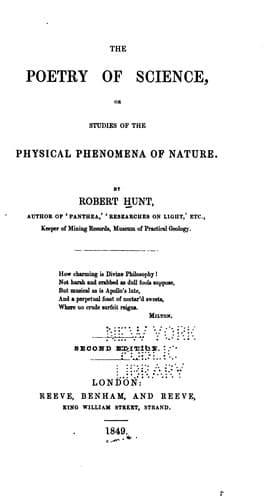
The Poetry of Science; or, Studies of the Physical Phenomena of NatureHunt, Robert
Philosophy
The Poetry of Science; or, Studies of the Physical Phenomena of Nature
Hunt, Robert
Physics; Science
There are, however, differences, and striking ones, between ordinary
and magnetic electricity. In the magnet we have a power at rest, and in
the electrical machine or galvanic battery, a power in motion. Ordinary
electricity is stopped in its passage by a plate of glass, of resin,
and many other substances; but magnetism passes these with freedom, and
influences magnetic bodies placed on the other side. It would appear,
though we cannot explain how, that magnetism is due to some lateral
influence of the electric currents. A magnetic bar is placed over a
copper wire, and it hangs steadily in the direction of its length;
an electric current is passed along it, and the magnet is at once
driven to place itself across the wire. Upon this experiment, in the
main, Ampère founds his theory of terrestrial magnetism. He supposes
electrical currents to be traversing our globe from east to west, and
thus, that the needle takes its direction, not from the terrestrial
action of any fixed magnetic poles, but from the repulsion of these
currents, as is the case with the wire.
It has been found that wires, freely suspended, along which currents
were passing in opposite directions, revolve about each other, or have
an inclination to place themselves at right angles; thus exhibiting
the same phenomenon as the magnet and the conducting wire. So far the
hypothesis of Ampère leads us most satisfactorily. We see in the magnet
one form of electricity, and in the machine or battery another. But why
should not the electricity of the magnet, electricity at rest, exhibit
the same powers as this force in motion?
Oersted, whose theory led him to the discovery of the fact of the
magnetic power of an electric current, of the establishment indeed of
the new science--ELECTRO-MAGNETISM, regards the phenomena of a current
passing a wire, and its action on a needle, as evidence of two fluids,
positive and negative, traversing in opposite directions, and mutually
attracting and repelling. He conceives that they pass the wires in a
series of spirals; that in the magnet, by some peculiar property of the
iron, this conflict of the currents is reduced to an equilibrium, and
its power becomes manifested in its attractive force.[171] This does
not, however, convey a clear idea to the mind.
It is curious that iron becomes magnetic in a superior degree to any
other metal; that steel retains permanently any magnetism imparted
to it; but that soft iron rapidly loses its magnetic power. This
must be in virtue of some peculiar arrangement of the molecules, or
some unknown physical condition of the atoms of the mass, by which a
continued influence is retained by the steel, probably in a state of
constant internal circulation. It has, however, been shown that soft
iron, under certain circumstances, may be made to retain a large amount
of magnetic force.[172]
Public-domain text, read in full here on John Shaqi.
Reviews
Reviews
No reviews yet
Be the first to share your thoughts on this work.
Elsewhere in the archive
Join the Discussion
Join the discussion
Sign in to leave a comment or review.
Sign InorCreate an account