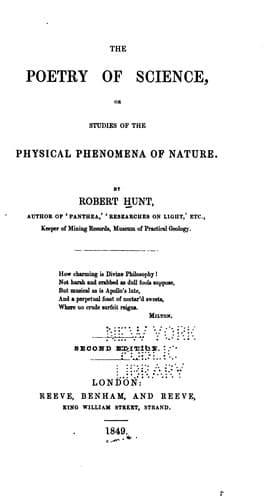
The Poetry of Science; or, Studies of the Physical Phenomena of NatureHunt, Robert
Philosophy
The Poetry of Science; or, Studies of the Physical Phenomena of Nature
Hunt, Robert
Physics; Science
If a horse-shoe shaped bar of soft iron is rendered magnetic by the
circulation of an electric current around it, while its two ends are
united by an armature of soft iron, so that it is capable of supporting
many hundred pounds weight; and we then, by breaking the circuit, stop
the current, taking care the armature is kept in contact, the iron will
not lose its magnetic property, but will retain this power for many
years. If the connecting piece of iron, the armature, is removed, the
bar immediately loses all its magnetism, and will not support even the
armature itself. This fact appears to confirm the idea that magnetism
is due to the retention of electricity, and that steel possesses
the property of equalizing the opposing forces, or of binding this
principle to itself like an atmosphere.
The influence of heat on magnetism is so remarkable a proof of the
dependence of this power upon molecular arrangement, that it must not
escape our notice. To select but one of many experiments by Mr. Barlow,
it was found that in a bar of malleable iron, in which, when cold, the
magnetic effect was + 30° 0', all polarity ceased at a white heat, that
it was scarcely appreciable at a red heat, but that at a blood-red heat
it was equal to + 41° 0'.[173]
The more closely we examine the peculiarities of the magnetic power,
and particularly as they are presented to us in its terrestrial action,
the more surprising will its influence appear to be. We have discovered
a natural cause which certainly exercises a very remarkable power
over matter, and we have advanced so far in our investigations as to
have learnt the secret of converting one form of force into another,
or of giving to a principle, produced by one agency, a new character
under new conditions; of changing, in fact, electricity into magnetism,
and from magnetism again evolving many of the effects of electrical
currents.
If a magnetic bar is freely suspended above the earth, it takes,
in virtue of some terrestrial power, a given direction, which is
an indication of the earth’s magnetic force. Whether this is the
consequence of the currents of electricity, which Ampère supposes to
circulate around the globe, from east to west, or the result of points
of attraction in the earth itself, the phenomenon is equally wonderful.
To whatever cause we may refer the visible effects, it appears certain
that this earth is composed of particles in a magnetic state, the
character varying with physical conditions, and that terrestrial
magnetic force is the collective action of all the atoms of this
planetary mass.[174]
Public-domain text, read in full here on John Shaqi.
Reviews
Reviews
No reviews yet
Be the first to share your thoughts on this work.
Elsewhere in the archive
Join the Discussion
Join the discussion
Sign in to leave a comment or review.
Sign InorCreate an account