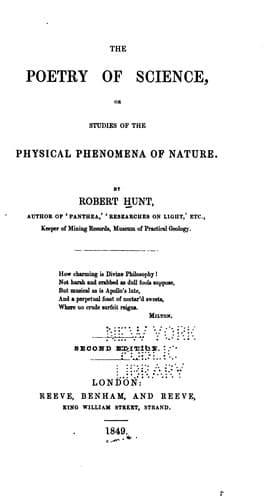
The Poetry of Science; or, Studies of the Physical Phenomena of NatureHunt, Robert
Philosophy
The Poetry of Science; or, Studies of the Physical Phenomena of Nature
Hunt, Robert
Physics; Science
In the beautiful Aurora borealis, with its trembling diffusive lights,
and its many-coloured rays, we have what may be regarded as a natural
exhibition of magnetism, and we appear to have within our grasp the
explanation we desire. But we know not the secret of even these
extraordinary meteorological displays. If we pass an electric spark
from a machine through a long cylinder, exhausted of air as far as
possible, we have a mimic representation of the Northern Lights--the
same attenuation of brightness, almost dwindling into phosphorescence;
and by the slightest change of temperature we may produce that play
of colours which is sometimes so remarkably manifested in Aurora. Dr.
Dalton considered Aurora borealis _as a magnetic phenomenon, and that
its beams are governed by the earth’s magnetism_. We know that the arc
of light produced between the poles of a powerful galvanic battery is
readily deflected by a good magnet; and we have lately learned that
every vapour obeys the magnetic force.[183] It is, therefore, yet a
question for our consideration, does the earth’s magnetism produce
the peculiar phenomena of Aurora by acting upon electricity in a
state of glow? or have we evidence in this display of the circulation
of the magnetic fluid around our globe, manifesting itself by its
action on the ferruginous and other metallic matter, which Fusinieri
has proved to exist in the upper regions of our atmosphere.[184] That
magnetic radiations do exist, has been proved by Faraday, and that they
form lines of force perpendicular to the earth’s surface, has been
experimentally shown. Parallelograms of wire moved upon a central axis,
and connected with a galvanometer, give at every revolution indication
of an electric disturbance in all respects analogous to the production
of a current by moving wires in front of a steel magnet.
The alteration in the properties of heat, when it passes from the
radiant state into combination with matter, exhibits to us something
like what we may suppose occurs in the conversion of magnetism into
electricity or the contrary. We have a subtile agent, which evidently
is for ever busy in producing the necessary conditions of change in
this our earth: an element to which is due the development of many of
the most active powers of nature; performing its part by blending with
those principles which we have already examined; associating itself
with every form of matter; and giving, as we shall presently see, in
all probability, the first impulses to combination, and regulating the
forms of aggregating particles.
Public-domain text, read in full here on John Shaqi.
Reviews
Reviews
No reviews yet
Be the first to share your thoughts on this work.
Elsewhere in the archive
Join the Discussion
Join the discussion
Sign in to leave a comment or review.
Sign InorCreate an account