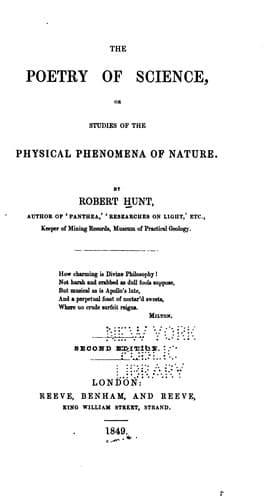
The Poetry of Science; or, Studies of the Physical Phenomena of NatureHunt, Robert
Philosophy
The Poetry of Science; or, Studies of the Physical Phenomena of Nature
Hunt, Robert
Physics; Science
As electricity has the power of altering the physical conditions of
the more adherent states of matter, thus giving rise to variations
of form and modes of combination, so gross matter appears to alter
the character of this agency, and thus disposes it to the several
modifications under which we have already detected its presence.
We have mechanical electricity and chemical electricity, each
performing its great work in nature; yet both manifesting conditions
so dissimilar, that tedious research was necessary before they could
be declared identical. Magnetic electricity is a third form; all its
characteristics are unlike the others, and the office it appears to
perform in the laboratory of creation is of a different order from
that of the other states of electrical force. In the first two we have
decomposing and recombining powers constantly manifested--in fact,
their influences are always of a chemical character; but in the last it
appears we have only a directive power. It was thought that evidence
had been detected of a chemical influence in magnetism; it did appear
that sometimes a retarding force was exerted, and often an accelerating
one. This has been again denied, and we have arrayed in opposition to
each other some of the first names among European experimentalists.
The question is not yet to be regarded as settled; but, from long and
tedious investigation, during which every old experiment has been
repeated, and numerous new ones tried, we incline to the conclusion
that chemical action is not directly affected by magnetic power. It
is highly probable that magnetism may, by altering the structural
arrangement of the surface, vary the rate of chemical action; but this
requires confirmation.[185]
There is no substance to be found in nature existing independently of
magnetic power. But it influences bodies in different ways: one set
acting with relation to magnetism, like iron, and arranging themselves
along the line of magnetic force,--these are called magnetic bodies;
another set, of which bismuth may be taken as the representative,
always placing themselves at right angles to this line,--these are
called _diamagnetic bodies_.[186] This is strikingly shown by means of
powerful electro-magnets; but the magnetism of the earth is sufficient,
under proper care, to exhibit the phenomena.
Every substance in nature is in one or other of these conditions. The
rocks, forming the crust of the earth, and the minerals which are
discovered in them; the surface soil, which is by nature prepared as
the fitting habitation of the vegetable world, and every tree, shrub,
and herb which finds root therein, with their carbonaceous matter, in
all its states of wood, leaf, flower, and fruit; the animal kingdom,
from the lowest monad through the entire series up to man,--have, all
of them, distinct magnetic or diamagnetic relations.
Public-domain text, read in full here on John Shaqi.
Reviews
Reviews
No reviews yet
Be the first to share your thoughts on this work.
Elsewhere in the archive
Join the Discussion
Join the discussion
Sign in to leave a comment or review.
Sign InorCreate an account