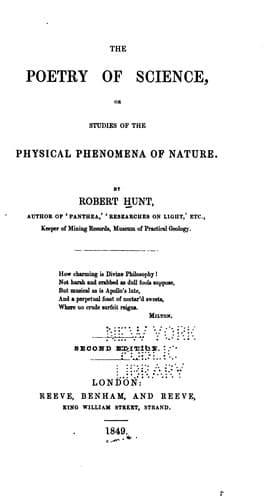
The Poetry of Science; or, Studies of the Physical Phenomena of NatureHunt, Robert
Philosophy
The Poetry of Science; or, Studies of the Physical Phenomena of Nature
Hunt, Robert
Physics; Science
Mitscherlich has remarked that crystals do not expand uniformly by
heat, but that this dilatation is greater in one direction than in
another; and that this difference is connected with their crystalline
form. M. de Sénarmont has shown that conductibility for heat,
which is equal in all directions for the crystals of the regular
system, acquires in others a maximum or a minimum value, according
to directions parallel to the crystallographic axes; so that the
isothermic surfaces, which are spheres in the former case, are, in the
other, ellipsoids elongated or flattened in the same direction. The
optical axes do not altogether coincide with the principal axes of
conductibility for heat; but this appears to be due merely to slight
differences in the rate of progression, or the refrangibility of the
luminous and calorific rays.
Wiedemann, by employing a fine point through which he made electricity
arrive upon a surface that he had powdered with licopodium or red lead,
succeeded in determining, by means of the form assumed by this light
powder, the conductibility of crystals in different directions.
On a surface of glass, the powder which disperses itself around the
points, in consequence of electric repulsion, forms a circular
figure traversed by radii. When a plate of gypsum is used instead of
glass the figure is found to be elliptical, and the great axis of
the ellipse forms a right angle with the principal crystallographic
axis, which proves that the electricity distributes itself more
easily in a direction perpendicular to the axis than in any other.
M. Wiedemann comes to the conclusion that crystals which possess a
better conductibility in the direction of the principal axis, all
belong to the class of negative crystals: while those which have a
better conductibility in the direction perpendicular to the axis are
positive, which indicates that the direction of best conductibility
for electricity is also that according to which light is propagated
relatively with greater velocity.
Tyndale has shown, that if gutta percha which has been rendered fibrous
in manufacture is cut so that the fibres are in the direction of this
greatest length, or in a direction perpendicular to this greatest
length, and placed under the influence of a magnet, they direct
themselves equatorially. Ivory cut in the same direction manifests the
same conditions, though both these substances are diamagnetic.
The fibrous structure, and the planes of cleavage, thus determine the
magnetic condition of a substance. The special properties presented by
crystals, in regard to the action exercised upon them by magnets, is
due to a particular mode of grouping their particles. This is also the
cause of unequal dilatability, and of unequal conductibility for heat
and for electricity.
How curiously, therefore, does molecular structure determine the
relation of a body to any of the forms of physical force!
Public-domain text, read in full here on John Shaqi.
Reviews
Reviews
No reviews yet
Be the first to share your thoughts on this work.
Elsewhere in the archive
Join the Discussion
Join the discussion
Sign in to leave a comment or review.
Sign InorCreate an account