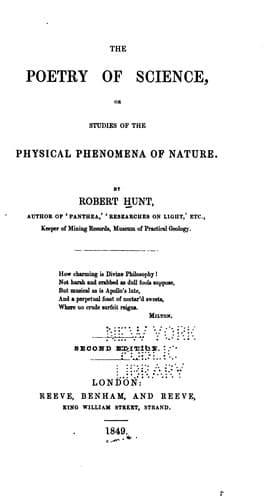
The Poetry of Science; or, Studies of the Physical Phenomena of NatureHunt, Robert
Philosophy
The Poetry of Science; or, Studies of the Physical Phenomena of Nature
Hunt, Robert
Physics; Science
We still search in the dark, and see but dimly the evidences; yet it
becomes almost a certainty to us, that this stone of granite, with its
curious arrangement of felspar, mica, and quartz, presents its peculiar
condition in virtue of some law of magnetic force. The crystal, too,
of quartz, which we break out of the mass, and which presents to us a
beautifully regular figure, is, beyond a doubt, so formed, because the
atoms of silica are each one impelled in obedience to one of these two
conditions of magnetism to set themselves in a certain order to each
other, which cannot be altered by human force without destruction.
All the laws which regulate the forms of crystals and amorphous bodies
are, to the greatest degree, simple. In nature the end is ever attained
by the easiest means; and the complexity of operation, which appears
sometimes to the observer, is only so because he cannot see the spring
by which the machine is moved.
The gaseous envelope, our atmosphere, is in a neutral state. Oxygen is
strikingly magnetic in relation to hydrogen gas, whilst nitrogen is as
singularly the contrary; and the same contrasts present themselves when
these gases are examined in their relation to common air. Thus, oxygen
being magnetic, and nitrogen the contrary, we have an equilibrium
established, and the result is a compound neutral in its relations to
all matter. All gases and vapours are found to be diamagnetic, but in
different degrees.[191] This is shown by passing a stream of the gas,
rendered visible by a little smoke, within the influence of a powerful
magnet.
These bodies are, however, found relatively to each other,--or even
to themselves, under different thermic conditions,--to change their
states, and pass from the magnetic to the diamagnetic class. Heat has a
very remarkable influence in altering these relations; and atmospheric
air at one temperature is magnetic to the same fluid at another: thus,
by thermic variations, attraction or repulsion may be alternately
maintained. By this it must be understood that a stream of air, at a
temperature elevated but a few degrees above that of an atmosphere of
the same kind into which it is passing, is deflected in one way by a
magnet; whereas, if the stream is colder than the bulk through which
it flows, it is bent in another way by the same force. In this respect
magnetism and diamagnetism show equally the influence of another
physical force, heat; and we may safely refer many meteorological
phenomena to similar alterations of condition in the atmosphere,
relative to the magnetic relations of the aërial currents.
Public-domain text, read in full here on John Shaqi.
Reviews
Reviews
No reviews yet
Be the first to share your thoughts on this work.
Elsewhere in the archive
Join the Discussion
Join the discussion
Sign in to leave a comment or review.
Sign InorCreate an account