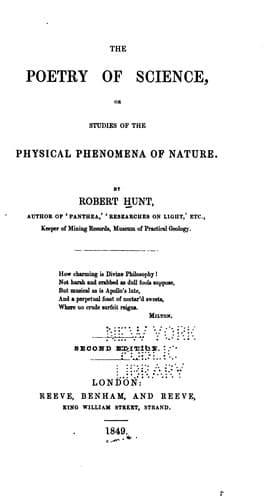
The Poetry of Science; or, Studies of the Physical Phenomena of NatureHunt, Robert
Philosophy
The Poetry of Science; or, Studies of the Physical Phenomena of Nature
Hunt, Robert
Physics; Science
Magnetism, in one or other of its forms, is now proved to be universal,
and to its power we are disposed to refer the structural conditions
of all material bodies, both organic and inorganic. This view has
scarcely yet been recognised by philosophers; but as we find a certain
law of polarity prevailing through every atom of created matter, in
whatever state it may be presented to our senses, it is evident that
every particle must have a polar and directing influence upon the mass,
and every coherent mass becomes thus only a larger and more powerful
representative of the magnetic unit. Thus we see the speculation of
Hansteen, that the sun is, to us, a magnetic centre, and that it
is equally influenced by the remoter suns of the universe,[198] is
supported by legitimate deductions from experiment.
The great difficulty is not, however, got rid of by this speculation;
the cause by which the earth’s magnetism is induced is only removed
further off.
The idea of a magnetic fluid is scarcely tenable; and the ferruginous
nature of the Aurora borealis receives no proof from any investigation;
indeed, we have procured evidence to show that iron is not at all
necessary for the production of magnetic phenomena. The leaf of a
tree, a flower, fruit, a piece of animal muscle, glass, paper, and a
variety of similar substances, have the power of repelling the bar of
iron which we call a magnet, and of placing it at right angles to the
direction of the force exerted by them. This is a point which must be
constantly borne in mind when we now consider the mysteries of magnetic
phenomena.
Any two masses of matter act upon each other according to this law,
and although by the power of cohesion the force may be brought to an
equilibrium, or to its zero point, it is never lost, and may be readily
and rapidly manifested by any of the means employed for electrical
excitation.
Reasoning by analogy, the question fairly suggests itself: If two
systems of inorganic atomic constitution are thus invested with a
power of influencing each other through a distance, why may not
two more highly developed organic systems equally, or to a greater
extent, produce an influence in like manner? Upon such reasoning as
this is founded the phenomenon known as Animal Magnetism. There is no
denying the fact that one mass of blood, muscle, nerves, and bone,
must, magnetically, influence another similar mass. This is, however,
something totally different from that abnormal condition which is
produced through some peculiar and, as yet, unexplained physiological
influences.
Public-domain text, read in full here on John Shaqi.
Reviews
Reviews
No reviews yet
Be the first to share your thoughts on this work.
Elsewhere in the archive
Join the Discussion
Join the discussion
Sign in to leave a comment or review.
Sign InorCreate an account