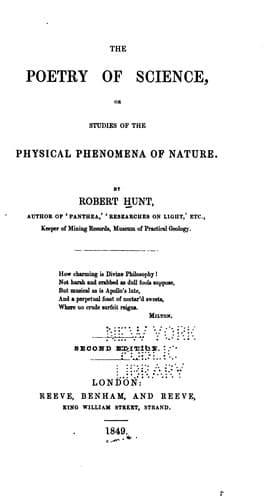
The Poetry of Science; or, Studies of the Physical Phenomena of NatureHunt, Robert
Philosophy
The Poetry of Science; or, Studies of the Physical Phenomena of Nature
Hunt, Robert
Physics; Science
“In seeking for a cause,” writes Sir David Brewster, “which is capable
of inducing magnetism on the ferruginous matter of our globe, whether
we place it within the earth, or in its atmosphere, we are limited to
the SUN, to which all the magnetic phenomena have a distinct reference;
but, whether it acts by its heat, or by its light, or by specific
rays, or influences of a magnetic nature, must be left to future
inquiry.”[195]
We have learnt that magnetism is not limited to ferruginous matter; we
know that the ancient doctrine of the universality of the property is
true. Kircher, in his strange work on Magnetism, published in the early
part of the seventeenth century[196]--a curious exemplification of the
most unwearying industry and careful experiment, combined with the
influences of the credulity and superstitions of his age--attributes to
this power nearly all the cosmical phenomena with which, in his time,
men were acquainted. He curiously anticipates the use of the supposed
virtue of magnetic traction in the curative art; and as the titles of
his concluding chapters sufficiently show, he was a firm believer in
animal magnetism.[197] But it is not with any reference to these that
we refer to the work of _Athanasii Kircheri, Societatis Jesu, Magnes,
sive de Magnetivâ Arte_, but to show that two hundred years since,
man was near a great truth; but the time of its development being not
yet come, it was allowed to sleep for more than two centuries, and
the shadow of night had covered it. In speaking of the vegetable
world, and the remarkable processes by which the leaf, the flower,
and the fruit are produced, this sage brings forward the fact of the
diamagnetic character of the plant, which has been, within the last two
years, re-discovered; and he refers the motions of the Sun-flower, the
closing of the Convolvulus, and the directions of the spiral, formed by
twining plants, to this particular influence.
This does not appear as a mere speculation, a random guess, but is
the result of deductions from experiment and observation. Kircher
doubtless leaped over a wide space to come to his conclusion; but the
result is valuable in a twofold sense. In the first it shows us that,
by neglecting a fact which is suggestive, we probably lose a truth
of great general application; and secondly, it proves to us, that by
stepping beyond the point to which inductive logic leads, and venturing
on the wide sea of hypothesis, we are liable to sacrifice the true to
the false, and thus to hinder the progress of human knowledge.
Public-domain text, read in full here on John Shaqi.
Reviews
Reviews
No reviews yet
Be the first to share your thoughts on this work.
Elsewhere in the archive
Join the Discussion
Join the discussion
Sign in to leave a comment or review.
Sign InorCreate an account