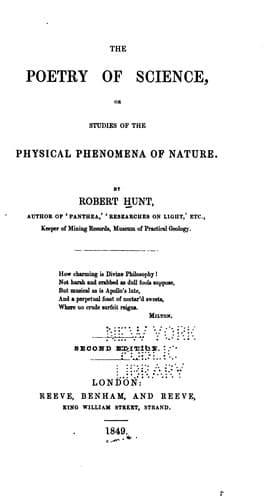
The Poetry of Science; or, Studies of the Physical Phenomena of NatureHunt, Robert
Philosophy
The Poetry of Science; or, Studies of the Physical Phenomena of Nature
Hunt, Robert
Physics; Science
Chemical affinity or attraction is the peculiar disposition which one
body has to unite with another. To give some instances in illustration.
Water and spirit combine most readily: they have a strong affinity for
each other. Water and oil repel each other: they have no affinity;
they will not enter into combination. If carbonate of potash is added
to the spirit and water in sufficient quantity, the water is entirely
separated, and the pure spirit will float over the hydrated potash. If
potash is added to the oil and water, it combines with the oil, and,
forming soap, they all unite together; but, if we now add a little acid
to the mixture, the potash will quit the oil to combine with the acid,
and the oil will be repelled as before and float on the liquid. This
has been called single elective affinity. These elections were regarded
as constant, and chemists drew up tables for the purpose of showing the
order in which these decompositions occur.[203] Thus, ammonia, it was
shown, would separate sulphuric acid from magnesia, lime remove it from
ammonia, potash or soda from lime, and barytes from potash or soda. It
was thought the inverse of this order would not take place, but recent
researches have shown that the results are modified by quantity and
some other conditions.
It often happens that we have a compound action of this kind in which
double election is indicated. Sulphate of lime and carbonate of ammonia
in solution are brought together, and there result a carbonate of lime
and a sulphate of ammonia. Now, in such cases nothing more than single
elective attraction most probably occurs, and the carbonic acid is
seized by the lime, by the great affinity of that earth for carbonic
acid, only after it has been set free from the ammonia, and then, by
the force of cohesion acting with the combining powers, the insoluble
salt is precipitated.[204] There is a curious fact in connection with
this decomposition. If carbonate of lime and sulphate of ammonia
are mixed together dry, and exposed, in a closed vessel, to a red
heat, sulphate of lime and carbonate of ammonia are formed. These
opposite effects are not very easily explained. The action of heat is
to set free the carbonic acid; and it can only be by supposing that
considerable differences of temperature reverse the laws of affinity,
that we can at all understand this phenomenon. That different effects
result at high temperatures from those which prevail at low ones,
recent experiments prove to us, particularly those of Boutigny, already
quoted when considering decomposition by calorific action.
Public-domain text, read in full here on John Shaqi.
Reviews
Reviews
No reviews yet
Be the first to share your thoughts on this work.
Elsewhere in the archive
Join the Discussion
Join the discussion
Sign in to leave a comment or review.
Sign InorCreate an account