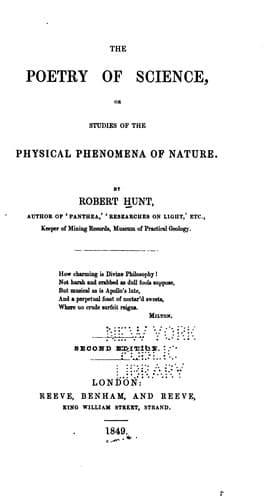
The Poetry of Science; or, Studies of the Physical Phenomena of NatureHunt, Robert
Philosophy
The Poetry of Science; or, Studies of the Physical Phenomena of Nature
Hunt, Robert
Physics; Science
Under the term chemical affinity, which we regard as a power acting
at insensible distances, and producing a change in bodies, we are
content to allow ourselves to believe that we have explained the
great operations of nature. We find that the vegetable and animal
kingdoms are composed of carbon, hydrogen, oxygen, and nitrogen. The
granite mountains of the earth, and its limestone hills, and all its
other geological formations, are found to be metals and oxygen, and
carbon and sulphur, disposed to settle in harmonious union in their
proper places by chemical affinity. But what really is the power which
combines atom to atom, and unites molecule to molecule? Can we refer
the process to heat? The influence of caloric, although by changing
the form of bodies it sometimes assists combination, is to be regarded
rather as in antagonism to the power of cohesion. Can it be thought
that electricity is active in producing the result? During every change
of state, those phenomena which we term electrical are manifested; but
we thereby only prove the general diffusion of the electric principle,
and by no means show that electricity is the cause of the chemical
change. Can light determine these changes? It is evident, although
light may be a disturbing power, that it cannot be the effective one;
for many of these decompositions and recompositions are constantly
going on within the dark and silent depths of the earth, to which a
sunbeam cannot reach. That the excitation on the surface of the earth,
produced by solar influence, may modify those changes, is probable. It
is, however, certain that we must regard all manifestations of chemical
force as dependent upon some secret principles common to all matter,
diffused throughout the universe, but modified by the influences of the
known imponderable elements, and by the mechanical force of aggregative
attraction.
Bodies undergo remarkable changes of form, and present very different
characters, by reactions, which are of several kinds. We suppose
that a permanent corpuscular arrangement is maintained so long as
the equilibrium of the molecular forces is undisturbed. Water, for
instance, remains unchanged so long as the balance of affinity is kept
up between the oxygen and hydrogen of which it is composed, or so long
as the oscillations of force between these combining elements are
equal; but disturb this force, or set up a new vibratory action, as by
passing an electric current through the water, or by presenting another
body, which has the power of reacting upon one of these corpuscular
systems, and the water is decomposed, the hydrogen and oxygen gases
being set free, or one alone is liberated, and the other combined with
the molecules of the agent employed, and a new compound produced. This
is chemistry, by which science we discover all the combinations of
matter.
Public-domain text, read in full here on John Shaqi.
Reviews
Reviews
No reviews yet
Be the first to share your thoughts on this work.
Elsewhere in the archive
Join the Discussion
Join the discussion
Sign in to leave a comment or review.
Sign InorCreate an account