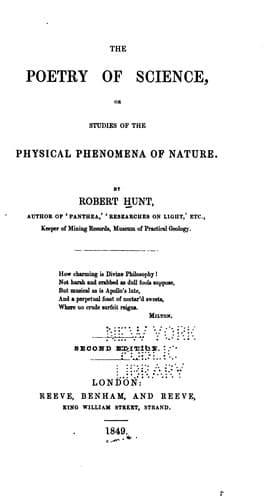
The Poetry of Science; or, Studies of the Physical Phenomena of NatureHunt, Robert
Philosophy
The Poetry of Science; or, Studies of the Physical Phenomena of Nature
Hunt, Robert
Physics; Science
Physical research has proved to us that all bodies have peculiar
powers, by which they condense with varying degrees of force gases
and vapours upon their surfaces; every body in nature may, indeed, be
regarded as forming its own peculiar atmosphere. To this power, in all
probability, does catalysis belong. Different views have, however,
prevailed on this subject, and Dr. Lyon Playfair[207] argues that the
catalytic force is merely a modified form of chemical affinity, exerted
under peculiar conditions.
Whatever may be the power producing chemical change, it acts in
conformity with some fixed laws, and in all its transmutations, an
obedience to a most harmonious system is apparent.
It is curious to observe the remarkable character of many of these
natural transmutations of matter, but we must content ourselves with a
few examples only. For instance:--
Sugar, oxalic acid, and citric acid are very unlike each other, yet
they are composed of the same elements; the first is used as a general
condiment, the second is a destructive poison, and the third a grateful
and healthful acid: sugar is readily converted into oxalic acid, and
in the process of ripening fruits nature herself converts citric acid
into sugar. Again, starch, sugar, and gum would scarcely be regarded
as alike, yet their only difference is in the mode in which carbon,
hydrogen, and oxygen combine. They are composed of the same principles,
in the following proportions:--
Carbon. Hydrogen. Oxygen.
Starch 12 10 10
Sugar 12 11 11
Gum 12 11 11
Public-domain text, read in full here on John Shaqi.
Reviews
Reviews
No reviews yet
Be the first to share your thoughts on this work.
Elsewhere in the archive
Join the Discussion
Join the discussion
Sign in to leave a comment or review.
Sign InorCreate an account