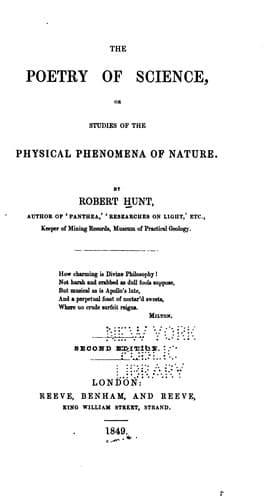
The Poetry of Science; or, Studies of the Physical Phenomena of NatureHunt, Robert
Philosophy
The Poetry of Science; or, Studies of the Physical Phenomena of Nature
Hunt, Robert
Physics; Science
Among the most remarkable phenomena within the range of physical
chemistry are those of _Catalysis_, or, as it has also been called, the
“_Action of presence_.”[205] There are a certain number of bodies known
to possess the power of resolving compounds into new forms, without
undergoing any change themselves. Kirchoff discovered that the presence
of an acid, at a certain temperature, converted starch into sugar and
gum, no combination with the acid taking place. Thenard found that
manganese, platinum, gold, and silver, and, indeed, almost any solid
organic body, had the power of decomposing the binoxide of hydrogen by
their presence merely, no action being detected on these bodies. Edmund
Davy found that powdered platinum, moistened with alcohol, became
red-hot, fired the spirit, and converted it into vinegar, without
undergoing, itself, any chemical change. Döbereiner next discovered
that spongy platinum fired a current of hydrogen gas directed upon
it, which, by combining with the oxygen of the air, formed water.
Dulong and Thenard traced the same property, differing only in degree,
through iridium, osmium, palladium, gold, silver, and even glass.
Further investigation has extended the number of instances; and it has
even been found that a polished plate of platinum has the power of
condensing hydrogen and oxygen so forcibly upon its surface, that these
gases are drawn into combination and form water, with a development of
heat sufficient to ignite the metal.
This power, whatever it may be, is common in both organic and inorganic
nature, and on its important purposes Berzelius has the following
remarks:--
“This power gives rise to numerous applications in organic nature;
thus, it is only around the eyes of the potato that diastase exists:
it is by means of catalytic power that diastase, and that starch,
which are insoluble, are converted into sugar and into gum, which,
being soluble, form the sap that rises in the germs of the potato.
This evident example of the action of catalytic power in an organic
secretion, is not, probably, the only one in the animal and vegetable
kingdom, and it may hereafter be discovered that it is by an action
analogous to that of catalytic power, that the secretion of such
different bodies is produced, all which are supplied by the same
matter, the sap in plants, and the blood in animals.”[206]
It is, without doubt, to this peculiar agency that we must attribute
the abnormal actions produced in the blood of living animals by the
addition of any gaseous miasma or putrid matter, of which we have, in
all probability, a fearful example in the progress of Asiatic cholera;
therefore the study of its phenomena becomes an important part of
public hygiène.
Public-domain text, read in full here on John Shaqi.
Reviews
Reviews
No reviews yet
Be the first to share your thoughts on this work.
Elsewhere in the archive
Join the Discussion
Join the discussion
Sign in to leave a comment or review.
Sign InorCreate an account