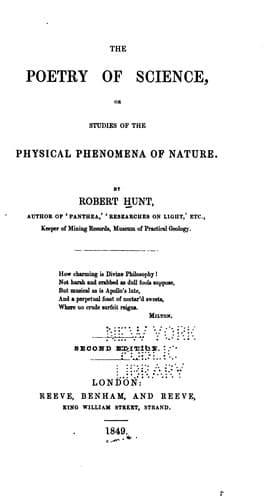
The Poetry of Science; or, Studies of the Physical Phenomena of NatureHunt, Robert
Philosophy
The Poetry of Science; or, Studies of the Physical Phenomena of Nature
Hunt, Robert
Physics; Science
There are some cases in which bodies appear to combine without any
limitation, as spirit of wine and water, sulphuric acid and water;
but these must be considered as conditions of mixture rather than of
chemical combination.
The composition of bodies is fixed and invariable, and a compound
substance, so long as it retains its characteristic properties, must
consist of the same elements united in the same proportions. Thus,
sulphuric acid is invariably composed of 16 parts of sulphur and 24
parts of oxygen. Chalk, whether formed by nature or by the chemist,
yields 43·71 parts of carbonic acid, and 56·29 parts of lime. The rust
which forms upon the surface of iron by the action of the atmosphere,
is as invariable in its composition as if it had been formed by the
most delicate adjustment of weight by the most accurate manipulator,
being 28 parts of iron and 12 parts of oxygen. This law is the basis of
all chemical inquiry, all analytical investigations depending upon the
knowledge it affords us, that we can only produce certain undeviating
compounds as the results of our decompositions. We are not in a
position to offer any explanation which will account for these constant
quantities in combination. The forces of cohesion and elasticity
have been advanced in explanation, on the strength of the fact that
the solubility of a salt in water is regulated by cohesion, and that
of a gas by its elasticity. Although it may appear that some cases
of chemical combination are due to these powers,--as, for instance,
when the union of oxalic acid or sulphuric acid with lime produces
an insoluble salt,--we cannot thus explain the constant proportions
in which the metals, sulphur, oxygen, and similar bodies, unite. It
is quite certain there is a power or principle, which we have not
yet reached, upon which are dependent all the phenomena which we now
embrace under the term chemical affinity.
Another law teaches us that when compound bodies combine in more than
one proportion, every additional union represents a multiple of the
combining proportion of the first. With the difficulty which arises
from the sub-multiple compounds we cannot deal:--further research may
render their laws less obscure. We have seen that 8 parts of oxygen
unite with 1 of hydrogen and 14 of nitrogen. It also unites with 110 of
silver, 96 of platinum, 40 of potassium, 36 of chlorine, and 200 parts
of mercury, giving rise to--
Water 9
Nitrous oxide 22
Oxide of silver 118
Oxide of platinum 104
Potash 48
Oxide of chlorine 44
Oxide of mercury 208
In these proportions, or in multiples of them, and in no others, will
these bodies unite with the acids or other compounds. It will, of
course, be understood that any other numbers may be adopted, provided
they stand in the same relation to each other.[208]
Public-domain text, read in full here on John Shaqi.
Reviews
Reviews
No reviews yet
Be the first to share your thoughts on this work.
Elsewhere in the archive
Join the Discussion
Join the discussion
Sign in to leave a comment or review.
Sign InorCreate an account