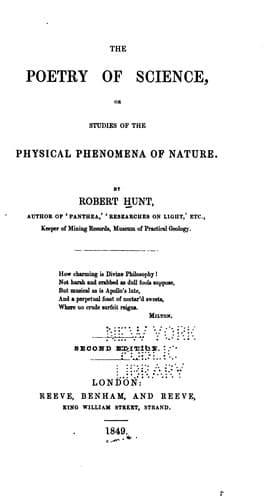
The Poetry of Science; or, Studies of the Physical Phenomena of NatureHunt, Robert
Philosophy
The Poetry of Science; or, Studies of the Physical Phenomena of Nature
Hunt, Robert
Physics; Science
From the discovery of these harmonious arrangements was deduced the
beautiful atomic theory to which allusion has been already made.
Indeed, there does not appear to be any other way of explaining these
phenomena than by the hypothesis that the ultimate atoms of bodies have
_relatively_ the weights which we arbitrarily assign to them, as their
combining quantities. These views are further confirmed by the fact,
that gaseous bodies unite together by volume in very simple definite
proportions:--100 measures of hydrogen and 200 measures of oxygen form
water; 100 measures of oxygen and 100 measures of vapour of sulphur
form sulphurous acid gas. Ammoniacal gas consists of 300 volumes of
hydrogen and 100 volumes of nitrogen, condensed by combination into 200
volumes; consequently, we are enabled most readily to calculate the
specific gravity of ammoniacal gas. The specific gravity of nitrogen
is 0·9722, that of hydrogen 0·0694. Now, three volumes of hydrogen are
equal to 0·2082: this added to 0·9722 is equal to 1·1804, which is
exactly the specific gravity obtained by experiment.
There is no doubt, from the generality with which this law of volumes
prevails, that it would be found to extend through all substances,
provided they could be rendered gaseous; in other words, there is
abundant proof to convince us that throughout nature the process of
combination, in the most simple ratio of volumes, is in operation to
produce all the forms of matter known to us.
It has been shown, by the investigations of Dr. Dalton, in 1840, that
salts, containing water of crystallization, dissolve in water without
increasing the bulk of the fluid more than is due to the liquefaction
of the water which these salts contain; while Joule and Playfair
have shown that the anhydrous salts take up no space in solution.
From this we are naturally led to conclude that the volume occupied
by a salt in the solid state has a certain relation to the volume of
the same salt when in solution, and has also a fixed relation to the
volume occupied by any other salt. The law appears to be:--the atomic
volume of any salt whatever (anhydrous or hydrated) is a multiple of
11, or of a number near 11, or a multiple of 9·8 (the atomic volume
of ice), or the sum of a multiple of 11 or 9·8. Marignac, who has
also paid much attention to the subject, does not think these numbers
absolutely correct, but approximately so.[209] It would be a beautiful
exemplification of the simplicity of Nature’s operations, if it should
be clearly proved that the atomic volume of solid water (ice) regulated
the combining proportions by volume of all other bodies,--that it was
the standard by which chemical combination and ordinary solution were
determined.
Public-domain text, read in full here on John Shaqi.
Reviews
Reviews
No reviews yet
Be the first to share your thoughts on this work.
Elsewhere in the archive
Join the Discussion
Join the discussion
Sign in to leave a comment or review.
Sign InorCreate an account