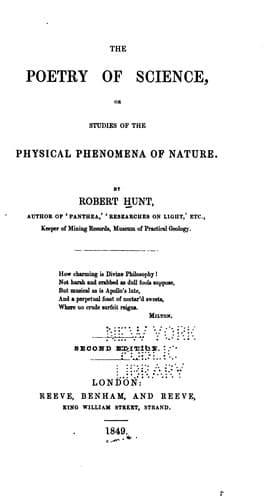
The Poetry of Science; or, Studies of the Physical Phenomena of Nature — John Shaqi
The Poetry of Science; or, Studies of the Physical Phenomena of NatureHunt, Robert
Philosophy
The Poetry of Science; or, Studies of the Physical Phenomena of Nature
Hunt, Robert
Physics; Science
[10] “The first great agent which the analysis of natural phenomena
offers to our consideration, more frequently and prominently than
any other, is force. Its effects are either, 1st, to counteract the
exertion of opposing force, and thereby to maintain _equilibrium_; or,
2ndly, to produce _motion_ in matter,
“Matter, or that whatever it be of which all the objects in nature
which manifest themselves directly to our senses consist, presents us
with two general qualities, which at first sight appear to stand in
contradiction to each other--activity and inertness. Its activity is
proved by its power of spontaneously setting other matter in motion,
and of itself obeying their mutual impulse, and moving under the
influence of its own and other force; inertness, in refusing to move
unless obliged to do so by a force impressed externally, or mutually
exerted between itself and other matter, and by persisting in its state
of motion or rest unless disturbed by some external cause. Yet, in
reality, this contradiction is only apparent. Force being the cause,
and motion the effect produced by it on matter, to say that matter is
inert, or has _inertia_, as it is termed, is only to say that the cause
is expended in producing its effect, and that the same cause cannot
(without renewal) produce double or triple its own proper effect.
In this point of view, equilibrium may be conceived as a continual
production of two opposite effects, each, undoing at every instant what
the other has done,”?--See continuation of the argument in _Herschel’s
Discourse on the Study of Natural Philosophy_, page 223.
In the Edinburgh New Philosophical Journal, vol. xlv., will be found a
paper by Dr Robert Brown--“_Of the sources of motions upon the Earth,
and of the means by which they are sustained_,” which will well repay
an attentive perusal, as pointing to a class of investigation of the
highest order, and containing deductions of the most philosophic
description.
[11] Friction, it is well known, generates heat; by rapidly rubbing two
sticks together, the Indian produces their ignition; heat and light
being both manifested. Under every mechanical disturbance electrical
changes can be detected, and the action of heat in the combustion of
the wood is a chemical phenomenon.
[12] Count Rumford’s experiment consisted in placing a mass of metal
in a box of water at a known temperature, and, by employing a boring
apparatus, ascertaining carefully the increase of heat after a given
number of revolutions. He thus describes his most satisfactory
experiment:--
Public-domain text, read in full here on John Shaqi.
Reviews
Reviews
No reviews yet
Be the first to share your thoughts on this work.
Join the Discussion
Join the discussion
Sign in to leave a comment or review.
Sign InorCreate an account