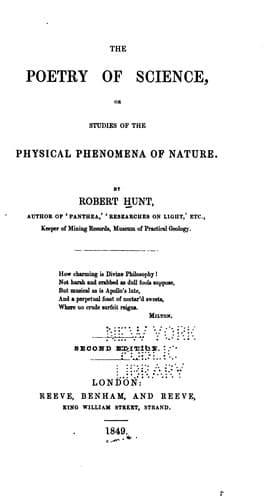
The Poetry of Science; or, Studies of the Physical Phenomena of NatureHunt, Robert
Philosophy
The Poetry of Science; or, Studies of the Physical Phenomena of Nature
Hunt, Robert
Physics; Science
The flower has grown under the impulse of principles which have
traversed to it on the solar beam, and mingled with its substance. A
stone is merely a stone to most men. But within the interstices of
the stone, and involving it like an atmosphere, are great and mighty
influences, powers which are fearful in their grander operations, and
wonderful in their gentler developments. The stone and the flower hold,
locked up in their recesses, the three great known forces--light, heat,
and electricity: and, in all probability, others of a more exalted
nature still, to which these powers are but subordinate agents. Such
are the facts of science, which, indeed, are the true “sermons in
stones,” and the most musical of “tongues in trees.” How weak are the
creations of romance, when viewed beside the discoveries of science!
One affords matter for meditation, and gives rise to thoughts of a most
ennobling character; the other excites for a moment, and leaves the
mind vacant or diseased. The former, like the atmosphere, furnishes
a constant supply of the most healthful matter; the latter gives
an unnatural stimulus, which compels a renewal of the same kind of
excitement, to maintain the continuation of its pleasurable sensations.
FOOTNOTES:
[200] All the phenomena connected with volcanic action, and the
theories connected therewith, will be found in Dr. Daubeny’s work, _A
description of active and extinct Volcanoes, of Earthquakes, and of
Thermal Springs_. 1848.
[201] Graham’s _Elements of Chemistry_. New Edition.
[202] Graham’s _Elements of Chemistry_; and Brande’s _Manual_.
[203] Of these _tables of attraction_ the following may be taken as a
specimen:--
SULPHURIC ACID.
Baryta.
Strontia.
Potassa.
Soda.
Lime.
Magnesia.
Ammonia.
It thus appears that baryta separates sulphuric acid from its compounds
with all inferior substances, and that ammonia is separated from the
acid by all that are above it.
[204] Berthollet: _Essai de Statique Chimique_, 1803. Sir Humphry Davy,
in his _Elements of Chemical Philosophy_, has given an excellent review
of the views of Berthollet.
Public-domain text, read in full here on John Shaqi.
Reviews
Reviews
No reviews yet
Be the first to share your thoughts on this work.
Elsewhere in the archive
Join the Discussion
Join the discussion
Sign in to leave a comment or review.
Sign InorCreate an account