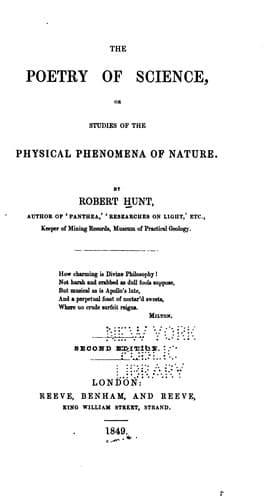
The Poetry of Science; or, Studies of the Physical Phenomena of NatureHunt, Robert
Philosophy
The Poetry of Science; or, Studies of the Physical Phenomena of Nature
Hunt, Robert
Physics; Science
A large portion of this planet is covered by the waters of the ocean,
of lakes and rivers. Water forms the best means of communication
between remote parts of the earth. It is in every respect of the
utmost importance to the animal and vegetable kingdom; and, indeed, it
is indispensable in all the great phenomena of the inorganic world.
The peculiarities of saltness or freshness in water are dependent
upon its solvent powers. The waters of the ocean are saline from
holding dissolved various saline compounds, which are received in
part from, and imparted also to, the marine plants. Perfectly pure
water is without taste: even the pleasant character of freshly-drawn
spring-water is due to the admixture of atmospheric air and carbonic
acid. The manner in which water absorbs air is evidently due to a
peculiar physical attractive force, the value of which we do not at
present clearly perceive or correctly estimate. It is chemically
composed of two volumes of hydrogen gas--the lightest body known, and
at the same time a highly inflammable one--united with one volume of
oxygen, which excites combustion, and continues that action,--producing
heat and light,--with great energy. By weight, one part of hydrogen
is united with eight of oxygen, or in 100 parts of water we find 88·9
oxygen, and 11·1 of hydrogen gas. That two such bodies should unite to
furnish the most refreshing beverage, and indeed the only natural drink
for man and animals, is one of the extraordinary facts of science.
Hydrogen will not support life--we cannot breathe it and live; and
oxygen would over-stimulate the organic system, and, producing a kind
of combustion, give rise to fever in the animal frame; but, united,
they form that drink, for a drop of which the fevered monarch would
yield his diadem, and the deprivation of which is one of the most
horrid calamities that can be inflicted upon any living thing. Water
appears as the antagonist principle to fire, and the ravages of the
latter are quenched by the assuaging powers of the former; yet a
mixture of oxygen and hydrogen gases, in the exact proportion in which
they form water, explodes with the utmost violence on the contact of
flame, and, when judiciously arranged, produces the most intense degree
of heat known;--such is the remarkable difference between a merely
mechanical mixture and a chemical combination. Beyond this, we have
already noticed the remarkable fact that water deprived of air is
explosive at a comparatively low temperature, less than 300°; gunpowder
requiring a temperature of nearly 1000° F.
Public-domain text, read in full here on John Shaqi.
Reviews
Reviews
No reviews yet
Be the first to share your thoughts on this work.
Elsewhere in the archive
Join the Discussion
Join the discussion
Sign in to leave a comment or review.
Sign InorCreate an account