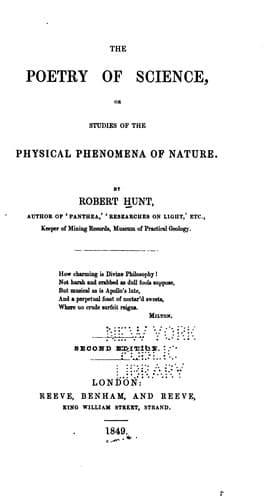
The Poetry of Science; or, Studies of the Physical Phenomena of NatureHunt, Robert
Philosophy
The Poetry of Science; or, Studies of the Physical Phenomena of Nature
Hunt, Robert
Physics; Science
[210] _Comptes Rendus de l’Académie des Sciences_, 1840, No. 5. A good
translation of Dumas’s Memoir appeared in the Philosophical Magazine,
from which I extract the following familiar exposition of the laws of
substitution:--“Let me make a comparison drawn from a familiar order of
ideas. Let us put ourselves in the place of a man overlooking a game at
chess without the slightest knowledge of the game. He would soon remark
that the pieces must be used according to positive rules. In chemistry,
the equivalents are our pieces, and the law of substitutions one of the
rules which preside over their moves. And as in the oblique move of the
pawns one pawn must be substituted for another, so in the phenomena
of substitution one element must take the place of another. But this
does not hinder the pawn from advancing without taking anything, as the
law of substitution does not hinder an element from acting on a body
without displacing or taking the place of any other element that it may
contain.”--_Memoir on the Law of Substitutions, and Theory of Chemical
Types._
[211] Liebig’s _Chemistry in its application to Agriculture and
Physiology_: translated by Lyon Playfair, Ph. D. _Animal Chemistry, or
Chemistry in its application to Physiology and Pathology_: by Justus
Liebig; translated by Wm. Gregory.
CHAPTER XII.
CHEMICAL PHENOMENA.
Water--Its Constituents--Oxygen--Hydrogen--Peroxide
of Hydrogen--Physical Property of Water--Ice--Sea
Water--Chlorine--Muriatic Acid--Iodine--Bromine--Compounds
of Hydrogen with Carbon--Combustion--Flame--Safety
Lamp--Respiration--Animal Heat--The Atmosphere--Carbonic
Acid--Influence of Plants on the Air--Chemical Phenomena of
Vegetation--Compounds of Nitrogen--Mineral Kingdom, &c. &c.
Without attempting anything which shall approach even to the character
of a sketch of chemical science, we may be allowed, in our search
after exalting truths, to select such examples of the results of
combination as may serve to elucidate any of the facts connected with
natural phenomena. In doing this, by associating our examination with
well-known natural objects or conditions, the interpretation afforded
by analysis will be more evident, and the operation of the creative
forces rendered more striking and familiar, particularly if at the same
time we examine such physical conditions as are allied in action, and
are sufficiently explanatory of important features.
Public-domain text, read in full here on John Shaqi.
Reviews
Reviews
No reviews yet
Be the first to share your thoughts on this work.
Elsewhere in the archive
Join the Discussion
Join the discussion
Sign in to leave a comment or review.
Sign InorCreate an account