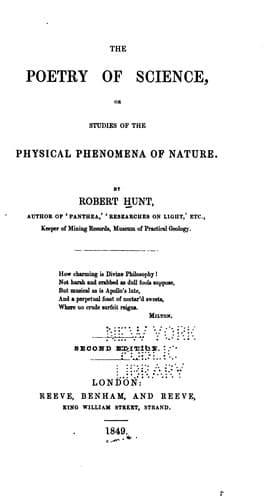
The Poetry of Science; or, Studies of the Physical Phenomena of NatureHunt, Robert
Philosophy
The Poetry of Science; or, Studies of the Physical Phenomena of Nature
Hunt, Robert
Physics; Science
nature, and produced under a great variety of circumstances. During
the excitation of an electrical machine, or the passage of a galvanic
current through water by the oxidation of phosphorus, and probably
in many similar processes--in particular those of combustion, and we
may therefore infer also of respiration--this body is formed. From
observations which have been made, it would appear that, during the
night, when the activity of plants is not excited by light, they act
upon the atmosphere in such a way as to produce this ozone; and its
presence is said to be indicated by its peculiar odour during the
early hours of morning. We are not yet acquainted with this body
sufficiently to speculate on its uses in nature: without doubt, they
are important, perhaps second to those of water only. It is probable,
as we have already had occasion to remark, that ozone may be the active
agent in removing from the atmosphere those organic poisons to which
many forms of pestilence are traceable; and it is a curious fact, that
a low electrical intensity, and a consequent deficiency of atmospheric
ozone, marks the prevalence of cholera, and an excess distinguishes the
reign of influenza.[214]
Some interesting researches appear to show the probability that ozone
is simply oxygen in a state of high activity. It has been found,
indeed, that perfectly dry oxygen, which will not bleach vegetable
colours in the dark, acquires, by exposure to sunshine, the power of
destroying them. Becquerel has proved that this ozonous state may be
produced in dry oxygen by passing a succession of electric sparks
through it. Fremy passed the electric sparks on the outside of a tube
which contained perfectly dry oxygen, and it was found to have acquired
the properties of ozone. In this case, and probably in the experiments
of Becquerel, the light of the spark, rather than the electricity,
appears to have been the active agent in producing this change.
Schönbein himself does not appear disposed to regard ozone as being
either peroxide of hydrogen, or an allotropic oxygen. He leans to his
first view of its being an entirely new chemical element. The energy
of this ozone is so great, that it has been found to destroy almost
instantaneously the Indian-rubber union joints of the apparatus in
which it is formed.[215]
Water, from the consideration of which a digression has been indulged
in, to consider the curious character of one of its elements,--water is
one of the most powerful chemical agents, having a most extensive range
of affinities, entering directly into the composition of a great many
crystallizable bodies and organic compounds. In those cases where it is
not combined as water, its elements often exist in the proportions in
which water is formed. Gum, starch, and sugar, only differ from each
other in the proportions in which the elements of water are combined
with the carbon.
Public-domain text, read in full here on John Shaqi.
Reviews
Reviews
No reviews yet
Be the first to share your thoughts on this work.
Elsewhere in the archive
Join the Discussion
Join the discussion
Sign in to leave a comment or review.
Sign InorCreate an account