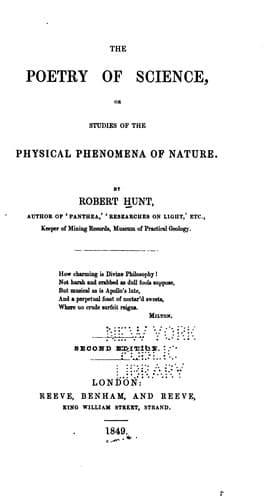
The Poetry of Science; or, Studies of the Physical Phenomena of NatureHunt, Robert
Philosophy
The Poetry of Science; or, Studies of the Physical Phenomena of Nature
Hunt, Robert
Physics; Science
In saline combinations, and also in many organic forms, we must regard
the water as condensed to the solid form; that is, to exist as ice. We
well know that, by the abstraction of heat, this condition is produced;
but, in chemical combinations, this change must be the result of the
mechanical force exerted by the power of the agency directing affinity.
In the case of water passing from a liquid to a solid state, we have a
most beautiful exemplification of the perfection of natural operations.
Water conducts heat downwards but very slowly; a mass of ice will
remain undissolved but a few inches under water, on the surface of
which, ether, or any other inflammable body, is burning. If ice (solid
water) swam beneath the surface, the summer sun would scarcely have
power to thaw it; and thus our lakes and seas would be gradually
converted into solid masses at our ordinary winter temperatures.
All similar bodies contract equally during the process of cooling,
from the highest to the lowest points to which the experiments have
been carried. It has been thought that if this applied to water,
the result would be the sudden consolidation of the whole mass. A
modification of the law has been supposed to take place to suit the
peculiar circumstances of water. Nature never modifies a law for a
particular purpose; we must, therefore, seek to explain the action of
the formation of ice, as we know it, by some more rational view.
Water expands by heat, and contracts by cold; consequently, the
coldest portions of this body occupy the lower portions of the fluid;
but it must be remembered that these parts are warmed by the earth.
Ross, however, states that at the depth of 1,000 fathoms the sea
has a constant temperature of 39°. Water is said to be at its point
of greatest density at 40° of Fahrenheit’s thermometer; in cooling
further, this fluid appears to expand, in the same way as if heated:
and, consequently, water colder than this point, instead of being
heavier, is lighter, and floats on the surface of the warmer fluid.
It does not seem that any modification of the law is required to
account for this phenomenon. Water cooled to 40° still retains its
peculiar corpuscular arrangement; but immediately it passes below that
temperature, it begins to dispose itself in such a manner that visible
crystals may form the moment it reaches 32°. Now, if we conceive
the particles of water, at 39°, to arrange themselves in the manner
necessary for the assumption of the solid form, by the particular
grouping of molecules in an angular instead of a spheroidal shape,
it will be clear, from what we know of the arrangement of crystals
of water--ice--that they must occupy a larger space than when the
particles are disposed, side by side, in minute spheres. Even the
escape of air from the water in which it is dissolved is sufficient to
give an apparent lightness to the colder water. This expansion still
goes on increasing, from the same cause, during the formation of ice,
Public-domain text, read in full here on John Shaqi.
Reviews
Reviews
No reviews yet
Be the first to share your thoughts on this work.
Elsewhere in the archive
Join the Discussion
Join the discussion
Sign in to leave a comment or review.
Sign InorCreate an account