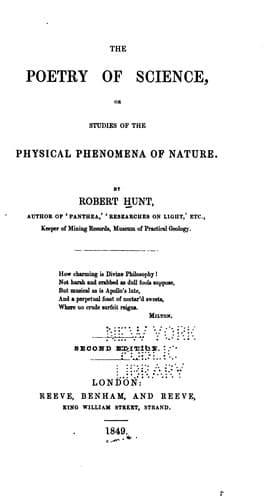
The Poetry of Science; or, Studies of the Physical Phenomena of NatureHunt, Robert
Philosophy
The Poetry of Science; or, Studies of the Physical Phenomena of Nature
Hunt, Robert
Physics; Science
The respiration of animals is an instance of the same kind of chemical
phenomena as we discover in ordinary combustion. In the lungs the blood
becomes charged with oxygen, derived from the atmospheric air, with
which it passes through the system, performing its important offices,
and the blood is returned to the lungs with the carbonic acid formed
by the separation of carbon from the body which is thrown off at every
expiration. It will be quite evident that this process is similar to
that of ordinary combustion. In man or animals, as in the burning
taper,--which is aptly enough employed by poets as the symbol of
life,--we have hydrogen and carbon, with some nitrogen superadded; the
hydrogen and oxygen form water under the action of the vital forces;
the carbon with oxygen produces carbonic acid, and, by a curious
process, the nitrogen and hydrogen also combine, to form ammonia.[222]
All the carbon which is taken into the animal economy passes, in
the process of time, again into the atmosphere, in combination with
oxygen, this being effected in the body, under the _catalytic_ power of
tissues, immediately influenced by the excitation of nervous forces,
which are the direct manifestations of vital energy. The quantity of
carbonic acid thus given out to the air is capable of calculation,
with only a small amount of error. It appears that upwards of fifty
ounces of carbonic acid must be given off from the body of a healthy
man in twenty-four hours. On the lowest calculation, the population of
London must add to the atmosphere daily 4,500,000 pounds of carbonic
acid. It must also be remembered that in every process for artificial
illumination, and in all the operations of the manufactures in which
fire is used, and also in our arrangements to secure domestic comfort,
immense quantities of this gas are formed. We may, indeed, fairly
estimate the amount, if we ascertain the quantity of wood and coal
consumed, of all the carbon which combines with oxygen while burning,
and escapes into the air, either as carbonic acid or carbonic oxide.
The former gas, the same as that which accumulates in deep wells
and in brewers’ vats, is highly destructive to life, producing very
distressing symptoms, even when mixed with atmospheric air, in but
slight excess over that proportion which it commonly contains. The
oppressive atmosphere of crowded rooms is in a great measure due to the
increased proportion of carbonic acid given off from the lungs of those
assembled, and collected in the almost stagnant air of badly ventilated
apartments. It will be evident to every one, that unless some provision
was made for removing this deleterious gas from the atmosphere as
speedily as it formed, consequences of the most injurious character to
the animal races would ensue. It is found, however, that the quantity
in the atmosphere is almost constantly about one per cent. The peculiar
properties of carbonic acid in part ensure its speedy removal. It is
Public-domain text, read in full here on John Shaqi.
Reviews
Reviews
No reviews yet
Be the first to share your thoughts on this work.
Elsewhere in the archive
Join the Discussion
Join the discussion
Sign in to leave a comment or review.
Sign InorCreate an account