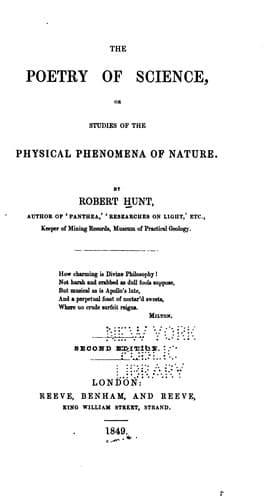
The Poetry of Science; or, Studies of the Physical Phenomena of NatureHunt, Robert
Philosophy
The Poetry of Science; or, Studies of the Physical Phenomena of Nature
Hunt, Robert
Physics; Science
among the heaviest of gaseous bodies, and it is readily absorbed by
water; consequently, floating within a short distance from the surface
of the earth, a large quantity is dissolved by the waters spread
over it. A considerable portion is removed by the vegetable kingdom;
indeed, the whole of that produced by animals, and by the processes
of combustion, eventually becomes part of the vegetable world, being
absorbed with water by the roots, and separated from the air by the
peculiar functions of the leaves. However, this heavy gas unites with
the lighter atmospheric fluid in obedience to that law which determines
the diffusion of different specific gravities through each other.
The leaves of plants may be regarded as performing similar offices
to the lungs of animals. They are the breathing organs. In the animal
economy a certain quantity of carbon is necessarily retained, in
combination with nitrogen and other elements, to form muscle; but this
is constantly undergoing change; the entire system being renewed within
a comparatively limited period. The conditions with plants are somewhat
different. For instance, the carbon is fixed in a tree, and remains
as woody fibre until it decays, even though the life of the plant may
extend over centuries.
Animals, then, are constantly supplying carbonic acid; plants are as
constantly feeding on it; thus is the balance for ever maintained
between the two kingdoms. Another condition is, however, required to
maintain for the uses of men and animals the necessary supply of oxygen
gas. This is effected by one of those wonderful operations of nature’s
chemistry which must strike every reflecting mind with admiration.
During the night plants absorb carbonic acid; but there is a condition
of repose prevailing then in their functions, and consequently their
powers of effecting the decomposition of this gas are reduced to their
minimum. The plant sleeps, and vital power reposes; its repose being as
necessary to the plant as to the animal. With the first gleam of the
morning sun the dormant energies of the plant are awakened into full
action; it decomposes this carbonic acid, secretes the carbon, to form
the rings of wood which constitute so large a part of its structure,
and pour out oxygen gas to the air. The plant is, therefore, an
essential element in the conditions necessary for the support of animal
life.
The animal produces carbonic acid in an exact proportion to the
quantity of carbonaceous matter which it consumes. Fruit and herbage
contain a small quantity of carbon in comparison with muscle and fat.
But let us confine our attention to the human race. Man within the
Tropics, where the natural temperature is high, does not require so
great an amount of chemical action to go on within him for the purpose
of maintaining the requisite animal heat; consequently his Maker has
surrounded him with fruits and grains which constitute his food.
Public-domain text, read in full here on John Shaqi.
Reviews
Reviews
No reviews yet
Be the first to share your thoughts on this work.
Elsewhere in the archive
Join the Discussion
Join the discussion
Sign in to leave a comment or review.
Sign InorCreate an account