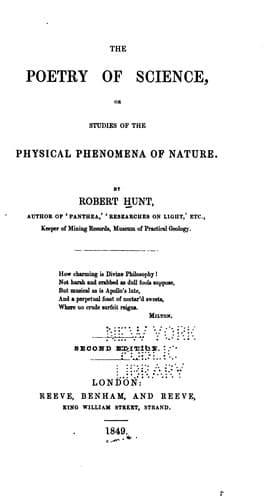
The Poetry of Science; or, Studies of the Physical Phenomena of NatureHunt, Robert
Philosophy
The Poetry of Science; or, Studies of the Physical Phenomena of Nature
Hunt, Robert
Physics; Science
As we advance to the colder regions of the earth man becomes a
flesh-eater, and his carnivorous appetite increases as the external
temperature diminishes. Eventually we reach the coldest zones, and the
human being there devours enormous quantities of fat to supply the
necessities of his condition.
It must necessarily follow, that the inhabitants of the tropics do not
produce so much carbonic acid as those who dwell in colder regions. In
the first place, their habits of life are different, and they are not
under the necessity of maintaining animal heat by the use of artificial
combustion, as are the people of colder climes. The vegetation of
the regions of the tropics is much more luxuriant than that of the
temperate and arctic zones. Hence an additional supply of carbonic acid
is required between the torrid zones, and a less quantity is produced
by its animals. These cases are all met by the great aërial movements.
A current of warmed air, rich in oxygen, moves from the equator towards
the poles, whilst the cooler air, charged with the excess of carbonic
acid, sets in a constant stream towards the equator. By this means the
most perfect equalization of the atmospheric conditions is preserved.
The carbonic acid poured out from the thousand mouths of our fiery
furnaces,--produced during the laborious toil of the hard-working
artizan,--and exhaled from every populous town of this our island
home,--is borne away by this our aërial currents to find its place
in the pines of the Pacific Islands, the spice-trees of the Eastern
Archipelago, and the cinchonas of Southern America. The plants of
the valley of the Caucasus, and those which flourish amongst the
Himalayas, equally with the less luxuriant vegetation of our temperate
climes, are directly dependent upon man and the lower animals for their
supply of food.
Public-domain text, read in full here on John Shaqi.
Reviews
Reviews
No reviews yet
Be the first to share your thoughts on this work.
Elsewhere in the archive
Join the Discussion
Join the discussion
Sign in to leave a comment or review.
Sign InorCreate an account