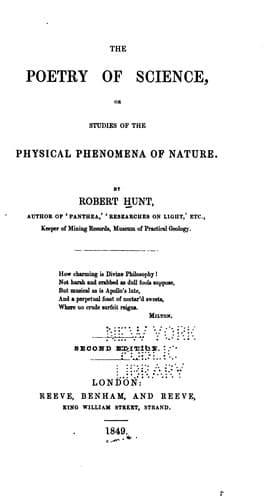
The Poetry of Science; or, Studies of the Physical Phenomena of NatureHunt, Robert
Philosophy
The Poetry of Science; or, Studies of the Physical Phenomena of Nature
Hunt, Robert
Physics; Science
A plant exposed to the action of natural or artificial decomposition
passes into air, leaving but a few grains of solid matter behind it.
An animal, in like manner, is gradually resolved into “thin air.”
Muscle, and blood, and bones, having undergone the change, are found to
have escaped as gases, leaving only “a pinch of dust,” which belongs
to the more stable mineral world. Our dependency on the atmosphere
is therefore evident. We derive our substance from it--we are, after
death, resolved again into it. We are really but fleeting shadows.
Animal and vegetable forms are little more than consolidated masses of
the atmosphere. The sublime creations of the most gifted bard cannot
rival the beauty of this, the highest and the truest poetry of science.
Man has divined such changes by the unaided powers of reason, arguing
from the phenomena which science reveals in unceasing action around
him. The Grecian sage’s doubts of his own identity, were only an
extension of a great truth beyond the limits of our reason. Romance and
superstition resolve the spiritual man into a visible form of extreme
ethereality in the spectral creations, “clothed in their own horror,”
by which their reigns have been perpetuated.
When Shakespeare made his charming Ariel sing--
“Full fathom five thy father lies,
Of his bones are coral made,
Those are pearls that were his eyes:
Nothing of him that doth fade,
But doth suffer a sea change
Into something rich and strange,”
he painted, with considerable correctness, the chemical changes
by which decomposing animal matter is replaced by a siliceous or
calcareous formation.
But the gifted have the power of looking through the veil of nature,
and they have revelations more wonderful than even those of the
philosopher, who evokes them by perpetual toil and brain-racking
struggle with the ever-changing elements around him.
Public-domain text, read in full here on John Shaqi.
Reviews
Reviews
No reviews yet
Be the first to share your thoughts on this work.
Elsewhere in the archive
Join the Discussion
Join the discussion
Sign in to leave a comment or review.
Sign InorCreate an account