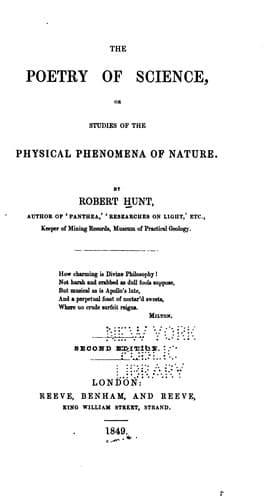
The Poetry of Science; or, Studies of the Physical Phenomena of NatureHunt, Robert
Philosophy
The Poetry of Science; or, Studies of the Physical Phenomena of Nature
Hunt, Robert
Physics; Science
The mysteries of flowers have ever been the charm of the poet’s song.
Imagination has invested them with a magic influence, and fancy has
almost regarded them as spiritual things. In contemplating their
surpassing loveliness, the mind of every observer is improved, and
the sentiments which they inspire, by their mere external elegance,
are great and good. But in examining the real mysteries of their
conditions, their physical phenomena, the relations in which they stand
to the animal world, “stealing and giving odours” in the marvellous
interchange of carbonic acid and ammonia for the soul-inspiring
oxygen--all speaking of the powers of some unseen, in-dwelling
principle, directed by a supreme ruler--the philosopher finds subjects
for deep and soul-trying contemplation. Such studies lift the mind into
the truly sublime of nature. The poet’s dream is the dim reflection of
a distant star: the philosopher’s revelation is a strong telescopic
examination of its features. One is the mere echo of the remote whisper
of nature’s voice in the dim twilight; the other is the swelling music
of the harp of Memnon, awakened by the sun of truth, newly risen from
the night of ignorance.
To return from our long, but somewhat natural digression, to a
consideration of the chemical phenomena connected with the atmosphere,
and its curious and important element, nitrogen, we must first examine
the evidence we have of the condition of the air itself.
The mean pressure exerted upon the surface of the earth, as indicated
by the barometer, is equal to a column of mercury thirty inches
high; that is, the column of air from the surface of the ocean to
its highest limits exactly balances that quantity of mercury. If our
tube of mercury had the area of one square inch, the columns would
weigh fifteen pounds, which represents a pressure of fifteen pounds
upon every square inch of the earth’s surface. This pressure, it must
be remembered, is the compound weight of the gaseous envelope, and
the elastic force of the aqueous vapour contained in it.[225] If the
atmosphere were of uniform condition, its height, as inferred from
the barometer, would be about five miles and a half. The density of
the air, however, diminishes with the pressure upon it, so that at the
height of 11,556 feet, the atmosphere is of half density; or one volume
of air, as taken at the surface of the earth, is expanded into two at
that height. Thus the weight is continually diminishing; but this is
regularly opposed by the decreasing temperature, which diminishes the
rate of about one degree for every 352 feet of ascent, although in all
probability it is less rapid at great distances from the earth.
Public-domain text, read in full here on John Shaqi.
Reviews
Reviews
No reviews yet
Be the first to share your thoughts on this work.
Elsewhere in the archive
Join the Discussion
Join the discussion
Sign in to leave a comment or review.
Sign InorCreate an account