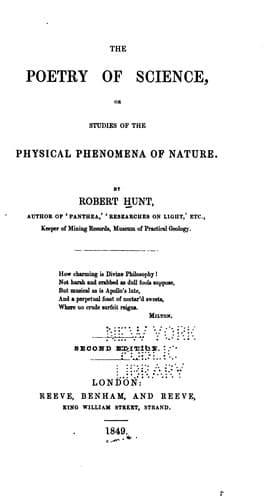
The Poetry of Science; or, Studies of the Physical Phenomena of NatureHunt, Robert
Philosophy
The Poetry of Science; or, Studies of the Physical Phenomena of Nature
Hunt, Robert
Physics; Science
It will now be evident that in all chemical phenomena we have the
combined exercise of the great physical forces, and evidences of some
powers which are, as yet, shrouded in the mystery of our ignorance. The
formation of minerals within the clefts of the rocks, the decomposition
of metallic lodes, the germination of seeds, the growth of the plant,
the development of its fruit and its ultimate decay, the secret
processes of animal life, assimilation, digestion, and respiration, and
all the changes of external form, which take place around us, are the
result of the exercise of that principle which we call chemical.
By chemical action plants take from the atmosphere the elements of
their growth; these they yield to animals, and from these they are
again returned to the air. The viewless atmosphere is gradually formed
into an organized being, the lordly tree upon whose branches the fowls
of the air have their homes, and the human animal, exalted by being
charged with a spiritual soul: yet the tree and the man alike are
gradually resolved again into thin air. The changes of the mineral
world are of an analogous character; but we cannot trace them so
clearly in all their phenomena.
The planet on which we live began its course charged with a fixed
quantity of physical force, and this has remained constant to the
present moment, and will do so to the end of time. By influences
external to this earth the balance of these forces is continually
disturbed; and in the effort to restore the equilibrium, we have the
production of all the varied forms of matter, and the manifestation of
each particular physical principle or power. As motion and attraction,
balanced against each other, maintain the earth in her elliptical
orbit, so the opposition of forces determines the existence of the
amorphous rock, the light-refracting crystal, the fixed and flowering
plant, and the locomotive animal.
An eternal round of chemical action is displayed in nature. Life and
death are but two phases of its influences. Growth and decay are
equally the result of its power.
FOOTNOTES:
[212] Dr. Priestley appears to have been the first to observe the
peculiar property of the diffusion of gases. Dr. Dalton, however,
first drew attention to the important bearing of this fact on natural
phenomena, and he published his views on _The Miscibility of Gases_ in
the Manchester Memoirs, vol. v. The following extract from his memoir
_On the Constitution of the Atmosphere_ will exhibit its bearings:--
It may be worth while to contrast this view of the constitution of the
atmosphere with the only other one, as far as I know, that has been
entertained.
Public-domain text, read in full here on John Shaqi.
Reviews
Reviews
No reviews yet
Be the first to share your thoughts on this work.
Elsewhere in the archive
Join the Discussion
Join the discussion
Sign in to leave a comment or review.
Sign InorCreate an account