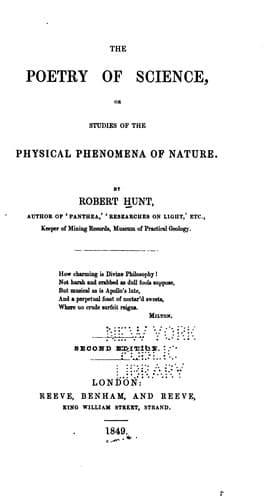
The Poetry of Science; or, Studies of the Physical Phenomena of NatureHunt, Robert
Philosophy
The Poetry of Science; or, Studies of the Physical Phenomena of Nature
Hunt, Robert
Physics; Science
The chemical elements, which actually exist in nature as simple
bodies, are probably but few. Most of the gases are in all probability
compounds of some ethereal ultimate principles; and with the advance of
science we may fairly hope to discover the means of reducing some of
them to a yet more simple state.
Curious relations, which can be traced through certain bodies, lead us
to believe that they may be only modified conditions of one element.
Flint and charcoal do not at first appear allied; but carbon in some
of its states approaches very near to the condition of silicon, the
metallic base of flint. When we remember the differences which are
evident in three forms of one body--coke, graphite, and diamond--the
dissimilitude between flint, a quartz crystal, and carbon, will cease
to be a strong objection to the speculation.
Phosphorus, sulphur, and selenium, have many properties in common.
Iodine, bromine, chlorine, and fluorine, appear to belong to the same
group. Iron and nickel, and cobalt, have a close relation. Silver and
lead are usually combined, and exhibit a strong relationship. Gold,
platinum, and the rarer metals, have so many properties in common, that
they may form a separate group from all the others.
Indeed, a philosophical examination of the elements now supposed to
constitute the material world, enables us to divide them into about six
well-defined groups. Wide differences exist within these groups; but
still we find a sufficient number of common properties to warrant our
classing them in one family.
The dream of the alchemists, in the vain endeavour to realise which
they exhausted their lives and dissipated their wealth, had its
foundation in a natural truth. The transmutation of one form of matter
into another may be beyond the power of man, but it is certainly
continually taking place in the laboratory of nature, under the
directing law of the great Creator of this beautiful earth.
The speculations of men, through all ages, have leaned towards this
idea, as is shown by the theory of the four elements,--Air, Fire,
Earth, and Water,--of the ancients, the three,--Salt, Sulphur, and
Mercury,--of the alchemists, and the refined speculations of Newton
and Boscovich on the ultimate constitution of matter. All experimental
inquiry points towards a similar conclusion. It is true we have no
direct evidence of any elementary atom actually undergoing a change
of state; but when we regard the variations produced by electrical
influence, the changes of state which arise from the power of heat, and
the physical alterations produced by light, it will be difficult to
come to any other conclusion than that the particles of matter known
to us as ultimate are capable of change, and consequently must be far
removed from positively simple bodies, since the real elementary atom,
possessing fixed properties, cannot be supposed capable of undergoing
any transmutation. Allotropism could not occur in any absolutely simple
body.
Public-domain text, read in full here on John Shaqi.
Reviews
Reviews
No reviews yet
Be the first to share your thoughts on this work.
Elsewhere in the archive
Join the Discussion
Join the discussion
Sign in to leave a comment or review.
Sign InorCreate an account