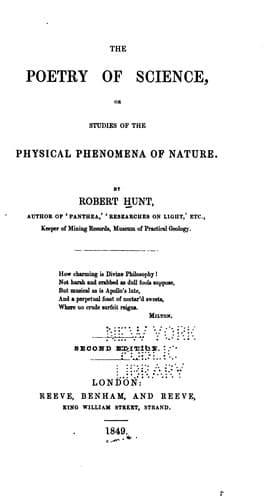
The Poetry of Science; or, Studies of the Physical Phenomena of NatureHunt, Robert
Philosophy
The Poetry of Science; or, Studies of the Physical Phenomena of Nature
Hunt, Robert
Physics; Science
The superficial crust of the earth,--by which is meant only that film,
compared with its diameter, which is represented by a few miles in
depth--is composed of distinct mineral masses, exhibiting peculiar
physical conditions and a certain order of arrangement. These rocks
appear to have resulted from two dissimilar causes; in one class the
action of heat is evident, and in the other we have either the slow
deposition of matter suspended in water, or crystallization from
solution; an aqueous origin is indicated by peculiarities of formation
in all the more recent rocks.
There are few branches of science which admit of speculation to the
extent to which we find it carried in geology. The consequences of this
are shown in the popular character of the science. A few observations
are made over a limited area, and certain structural conditions are
ascertained, and at once the mind, “fancy free,” penetrates the
profound depths of the earth, and imagination, having “ample room
and verge enough,” creates causes by which every effect is to be
interpreted. Such students, generally ignorant of the first principles
of physics, knowing little of mineralogy, and less of chemistry, to
say nothing of palæontology, having none of the requisites for an
observer, boldly assume premises which are untenable, and think they
have explained a phenomenon,--given to the world a truth,--when they
have merely promulgated an unsubstantiated speculation, which may have
occasional marks of ingenuity, and but little else.
The carefully-made observations of those who, with unwearying industry,
have traversed hill and valley, marked and measured the various
characters, thicknesses, inclinations, and positions of rocks; who have
watched the influences of heat in changing, of water in wearing, and
the results of precipitation in forming, strata; who have traced the
mechanical effects of earthquake strugglings and of volcanic eruptions,
and, reasoning from an immense mass of accumulated facts, deduced
certain general conclusions,--are, however, of a totally different
character; and it is such observers as these who induced Herschel to
say truly, that “geology, in the magnitude and sublimity of the objects
of which it treats, undoubtedly ranks, in the scale of the sciences,
next to astronomy.”[231]
The origin of this planet is involved in great obscurity, which the
powers of the most gifted are unable to penetrate. It stands the work
of an Almighty and Eternal mind, the beginning of which we cannot
comprehend, nor can we define the period of its termination.
Public-domain text, read in full here on John Shaqi.
Reviews
Reviews
No reviews yet
Be the first to share your thoughts on this work.
Elsewhere in the archive
Join the Discussion
Join the discussion
Sign in to leave a comment or review.
Sign InorCreate an account