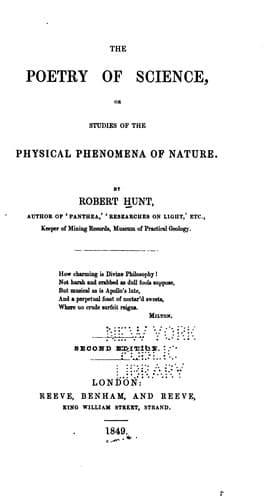
The Poetry of Science; or, Studies of the Physical Phenomena of NatureHunt, Robert
Philosophy
The Poetry of Science; or, Studies of the Physical Phenomena of Nature
Hunt, Robert
Physics; Science
It may, probably, be safe to speculate that there was a time when
this globe consisted of only one homogeneous stratum. Whether
this remains,--whether, in our plutonic rocks, our granites, or
our porphyries, we have any indications of the primitive state of
the world, or whether numerous changes took place before even our
unstratified formations had birth, are questions we cannot answer. The
geologist looks back into the vista of time, and reckons, by phenomena,
the progress of the world’s mutations. The stratified formations
must have occupied thousands of ages; but before these were, during
a period extending over countless thousands, the unstratified rocks
may have been variously metamorphosed. It matters not whether we admit
the nebular hypothesis or not,--a time must have been when all these
bodies which now form the mass of this globe existed in the most simple
state. We have already shown that very remarkable changes in external
character and in chemical relations are induced, in the same simple
element, by its having been exposed to some peculiar and different
conditions; and already have we speculated on the probability that
the advance of science will enable us to reduce the numerous elements
we now reckon, to two or three. It is, therefore, by no means an
irrational thought (which must, however, be held in the light of a
pure conjecture), to suppose that at the beginning a mighty mass of
matter, in the most attenuated state, was produced in space, and was
gradually, under the influence of gravitation, of cohesive force, and
of chemical aggregation, moulded into the form of a sphere. Ascending
to the utmost refinement of physics, we may suppose that this mass was
of one uniform character, and that it became in dissimilar parts--its
surfaces and towards its centre--differently constituted, under the
influences of the same powers which we now find producing, out of the
same body, charcoal and the diamond, and creating the multitudinous
forms of organized creations. These conditions being established, and
carried to an extent of which, as yet, science has afforded us no
evidence, chemical intermixture may have taken place, and a new series
of compounds have been formed, which, by again combining, gave rise to
another and more complex class of bodies.
Public-domain text, read in full here on John Shaqi.
Reviews
Reviews
No reviews yet
Be the first to share your thoughts on this work.
Elsewhere in the archive
Join the Discussion
Join the discussion
Sign in to leave a comment or review.
Sign InorCreate an account